🧀 Shredded Cheese Per Person Calculator
Calculate exactly how much shredded cheese you need for any dish or gathering
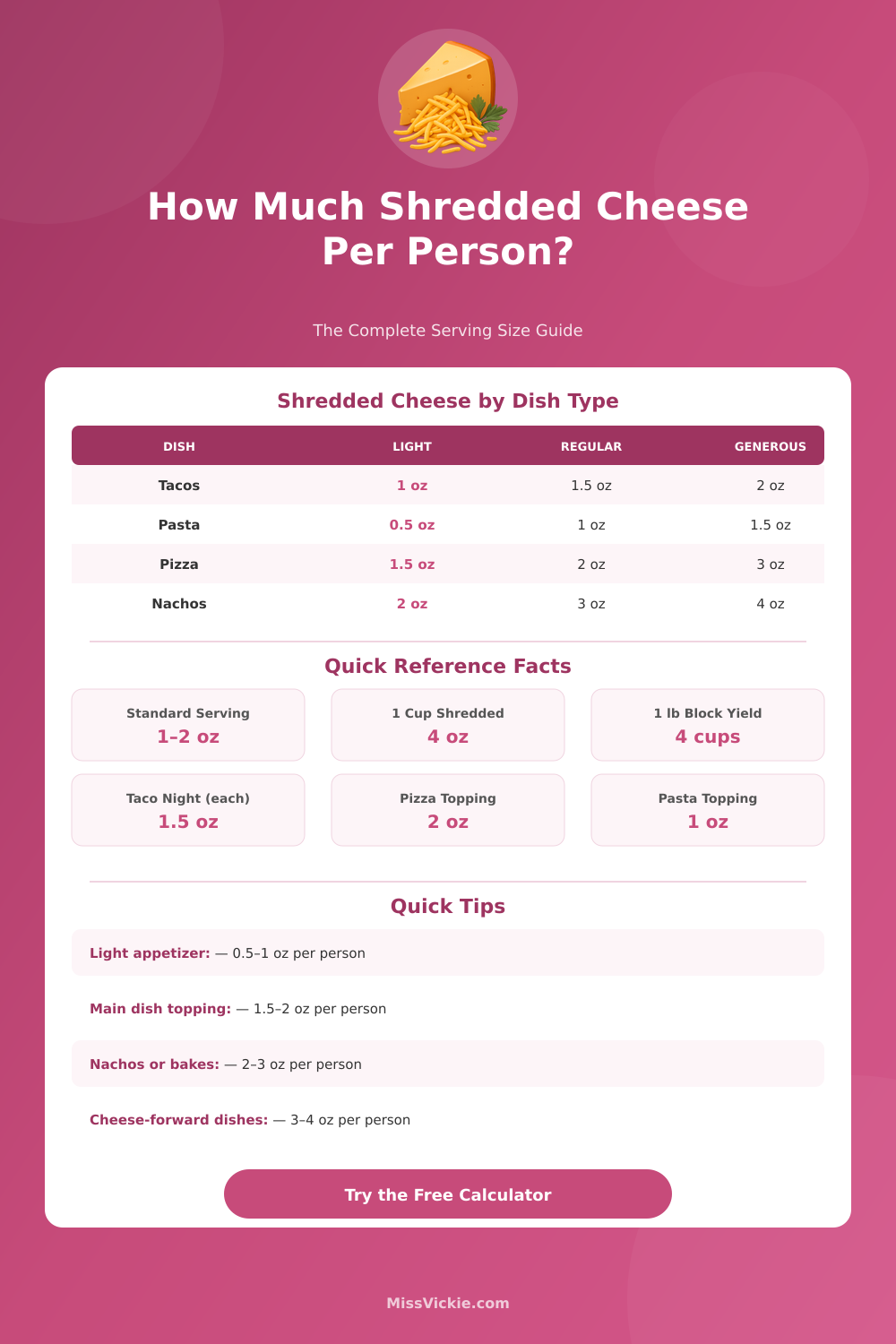
| Dish | Light (oz) | Regular (oz) | Generous (oz) | Light (g) | Regular (g) | Generous (g) |
|---|---|---|---|---|---|---|
| Tacos / Burritos | 1.0 | 1.5 | 2.5 | 28g | 43g | 71g |
| Pasta Topping | 0.5 | 1.0 | 1.5 | 14g | 28g | 43g |
| Pizza Topping | 1.5 | 2.0 | 3.0 | 43g | 57g | 85g |
| Nachos | 2.0 | 3.0 | 4.0 | 57g | 85g | 113g |
| Salad Topping | 0.25 | 0.5 | 1.0 | 7g | 14g | 28g |
| Burgers / Sandwiches | 0.5 | 1.0 | 1.5 | 14g | 28g | 43g |
| Casserole / Bake | 1.5 | 2.5 | 4.0 | 43g | 71g | 113g |
| Soup Topping | 0.25 | 0.75 | 1.0 | 7g | 21g | 28g |
| Baked Potatoes | 0.75 | 1.5 | 2.0 | 21g | 43g | 57g |
| Chili Topping | 0.5 | 1.0 | 1.5 | 14g | 28g | 43g |
| Measurement | Ounces | Grams | Cups |
|---|---|---|---|
| 1 standard handful | ~1 oz | ~28g | ~1/4 cup |
| 1/4 cup shredded | 1 oz | 28g | 0.25 cup |
| 1/2 cup shredded | 2 oz | 57g | 0.5 cup |
| 1 cup shredded | 4 oz | 113g | 1 cup |
| 2 cups shredded | 8 oz | 227g | 2 cups |
| 4 cups shredded | 16 oz (1 lb) | 454g | 4 cups |
| 1 standard bag (8 oz) | 8 oz | 227g | 2 cups |
| 1 large bag (16 oz) | 16 oz | 454g | 4 cups |
| 1 lb block → shredded yield | 16 oz | 454g | ~4 cups |
| 2 lb block → shredded yield | 32 oz | 907g | ~8 cups |
| Cheese Variety | Best For | Melt Quality | Oz per Serving |
|---|---|---|---|
| Mild Cheddar | Tacos, burgers, baked potato | Excellent | 1–2 oz |
| Sharp Cheddar | Casseroles, chili, soup | Good | 1–1.5 oz |
| Mozzarella | Pizza, pasta, bakes | Excellent | 1.5–3 oz |
| Mexican Blend | Tacos, nachos, burritos | Very Good | 1.5–2.5 oz |
| Monterey Jack | Quesadillas, nachos | Excellent | 1.5–2 oz |
| Parmesan | Pasta, salads, soups | Fair (garnish) | 0.25–0.5 oz |
| Colby Jack | Burgers, wraps, bakes | Good | 1–2 oz |
| Pepper Jack | Spicy tacos, nachos | Very Good | 1–1.5 oz |
shredded cheese shows up everywhere in the kitchen, seriously it appears in soups, on pizzas, in pasta foods with cheese, in nachos, tacos, salads, even on baked potatoes. Honestly many are the ways one can use it, if one only pauses and thinks about that.
In the year 1958, Sargento was the first company that sold shredded cheese to regular buyers. Today they still do that too, using blocks from real, natural cheese. Even so not every bag of pre-shredded cheese on the store shelves has the same quality.
Shredded Cheese: Uses, Problems and Tips
The cheese in those bags has stuff against clumping, to stop the bits from sticking together in one big lump. That can be cellulose, starch from potatoes, flour from corn or silicon dioxide. Cellulose absorbs the moisture that otherwise would make everything stick together.
Wood pulp as such an agent is not dangerous, but it causes real concerns when companies use too much or do not mention it clearly. Some products even carry a surprisingly big amount of cellulose filler mixde between it.
Here is where it gets really stressful. Those extras do stop good melting. Pre-shredded cheese does not melt to that smooth, sticky texture that real block cheese gives; it commonly becomes clumpy instead.
It matters a lot when one prepares cheese sauce, fondue or pizza. If one only sprinkles it on baked potatoes or mixes in salad? Then it probably works.
One good trick is soaking the pre-shredded cheese in water first, to remove the anti-clumping extras, witch certainly helps for better melting.
Shredding block cheese at home beats both the extra extras and the price of store bought. Pre-shredded cheese costs more, because one pays for the ease. In that bag is cellulose, empty space and the cheese itself.
Block gives more pure cheese for the same price. The key to good home shredding is using the cheese cold and hard, like this it cuts cleanly, instead of becoming a messy, sticky chaos. A food processor with a shredding blade works well, but cleaning it later is annoying.
A box grater is another option that gives thin, broad strips and leaves fewer scraps.
Freshly shredded cheese stays in a sealed bag in the refrigerator for some weeks without growing mould. One can also freeze shredded cheese, if it is meant for cooked dishes like pizza, lasagna or quesadillas. Splitting it into smaller parts before freezing makes things easier.
However shredded cheese goes bad more quickly than block, so best use it soon rather thanlate.
Common types that come pre-shredded are cheddar, mozzarella, Monterey Jack, parmesan, Colby Jack and pepper jack. Mixes in fiesta style that combine several cheeses are also liked. Especially for nachos, shredded cheese beats cheese sauce, because that sauce commonly makes the chips too dry and unappealing.