🍚 Rice to Water Ratio Calculator
Get the perfect water amount for any rice type and serving size — in cups or metric
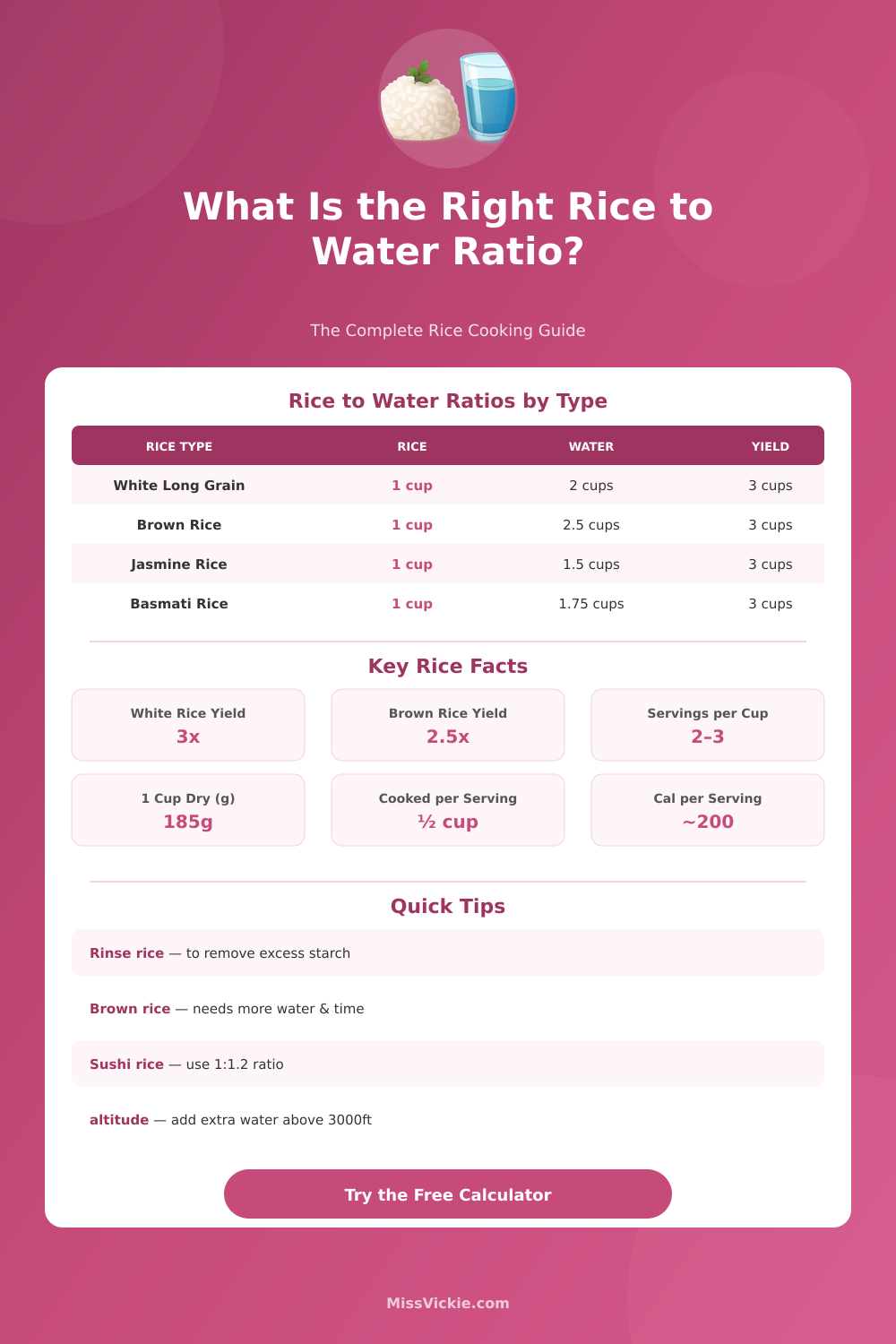
| Rice Type | Water Ratio | Water (cups) | Water (mL) | Cooked Yield | Servings |
|---|---|---|---|---|---|
| White Long Grain | 1 : 2.0 | 2 cups | 473 mL | 3 cups | 2–3 |
| White Short Grain | 1 : 1.75 | 1¾ cups | 414 mL | 3 cups | 2–3 |
| Brown Rice | 1 : 2.5 | 2½ cups | 591 mL | 3 cups | 2–3 |
| Jasmine Rice | 1 : 1.5 | 1½ cups | 355 mL | 3 cups | 2–3 |
| Basmati Rice | 1 : 1.75 | 1¾ cups | 414 mL | 3 cups | 2–3 |
| Sushi Rice | 1 : 1.2 | 1⅓ cups | 284 mL | 2½ cups | 2 |
| Arborio Rice | 1 : 3.0 | 3 cups | 710 mL | 3½ cups | 3–4 |
| Wild Rice | 1 : 3.0 | 3 cups | 710 mL | 4 cups | 3–4 |
| Black Rice | 1 : 2.0 | 2 cups | 473 mL | 3 cups | 2–3 |
| Red Rice | 1 : 2.25 | 2¼ cups | 532 mL | 3 cups | 2–3 |
| Rice Type | Calories | Carbs (g) | Protein (g) | Fiber (g) | GI Index |
|---|---|---|---|---|---|
| White Long Grain | 242 | 53.2 | 4.4 | 0.6 | 64–72 |
| Brown Rice | 216 | 44.8 | 5.0 | 3.5 | 50–55 |
| Jasmine Rice | 238 | 52.5 | 4.2 | 0.7 | 68–80 |
| Basmati Rice | 210 | 45.6 | 4.4 | 0.9 | 50–58 |
| Sushi Rice | 235 | 51.5 | 4.3 | 0.4 | 72–83 |
| Wild Rice | 166 | 35.0 | 6.5 | 3.0 | 45–55 |
| Black Rice | 200 | 42.5 | 5.3 | 2.0 | 42–50 |
| Dry Rice | Dry (cups) | Dry (grams) | Cooked Yield | Servings |
|---|---|---|---|---|
| ½ cup | 0.5 cup | ~93g | 1.5 cups | 1 |
| 1 cup | 1 cup | ~185g | 3 cups | 2–3 |
| 1½ cups | 1.5 cups | ~278g | 4.5 cups | 3–4 |
| 2 cups | 2 cups | ~370g | 6 cups | 4–6 |
| 3 cups | 3 cups | ~555g | 9 cups | 6–9 |
| 4 cups | 4 cups | ~740g | 12 cups | 8–12 |
| 5 cups | 5 cups | ~925g | 15 cups | 10–15 |
| Cooking Method | Adjustment | Example (1 cup white rice) | Why |
|---|---|---|---|
| Stovetop | Base (no change) | 2 cups water | Standard evaporation |
| Rice Cooker | –2 tbsp | 1¾ cups water | Less steam escapes |
| Instant Pot | –25% | 1½ cups water | Pressure seals moisture |
| Microwave | +2 tbsp | 2¼ cups water | Faster evaporation |
Rice is made up of cereal grains and ranks among the main foods globally. In its farmed form, it feeds more than half of the world population, especially in Asia and Africa. The seed of the grassy plant Oryza sativa form the Asian rices.
There also exist less spread species called Oryza glaberrima known as African rice. This crisp, edible grain backs almost half of the folks on the globe as everyday base for life.
Rice Types and How to Cook Them
In more than 100 nations Rice serves as basic food. Many households include it in two or more meals. It has high calorie and starch, while its price stays low.
Because of that cheap access, folks around the world can depend on it daily without troubles.
The world has more than 120 000 various Rice types. One sorts them according to grind level, grain size, starch amount and flavors. Some have long grains, other short.
The Indian basmati belong to the fluffy, long grain rices, that well agrees with curries, dals and for making pulao. Various Rice types cook differently, hence recipe for long white Rice does not work for swapping with otehr species.
Compared with other grains as barley, oats or wheat, Rice stores more starch but fewer proteins. It can replace buns or pasta in meals. Brown Rice is rich in antioxidants called phenols and flavonoids, that protects cells against damage and lower the chance of early aging.
Regarding white Rice, a serving of whole grain Rice gives more fibers, proteins and nutrients.
The servings range according to the species. For white or brown Rice, adult serving matches to half cup cooked. When dealing about basmati or quinoa, one takes only a quarter cup for adult.
One cup of raw brown Rice grains give around three cups after cook, quite a lot for three people. Half cup of cooked white Rice have 102 calories.
A Rice cooker helps to prepare it always just as well. It allows you to reach soft, firm or something in between. Upper quality of Rice shines truly when one cooks it well.
Rice is like olive oil: the good types surprise, wile the middle ones just disappoint. If one washes the rices in bucket before cook and leaves them rest some minutes after the process before mixing, that changes everything. Like this one gets fluffy, tender rices instead of sticky or cracked.
One can turn rices into many dishes. Dosa prepares from cooked Rice mixed with urad dal and fermented quickly. Rice congee involves boiling rices in broth and Water, later smoothing the mix.
Fried Rice bids other option, that starts by means ofcooked white Rice and tossing onions in warm oil together with it.