🥑 Keto Macro Calculator
Calculate your personalized daily fat, protein & carb targets for ketosis
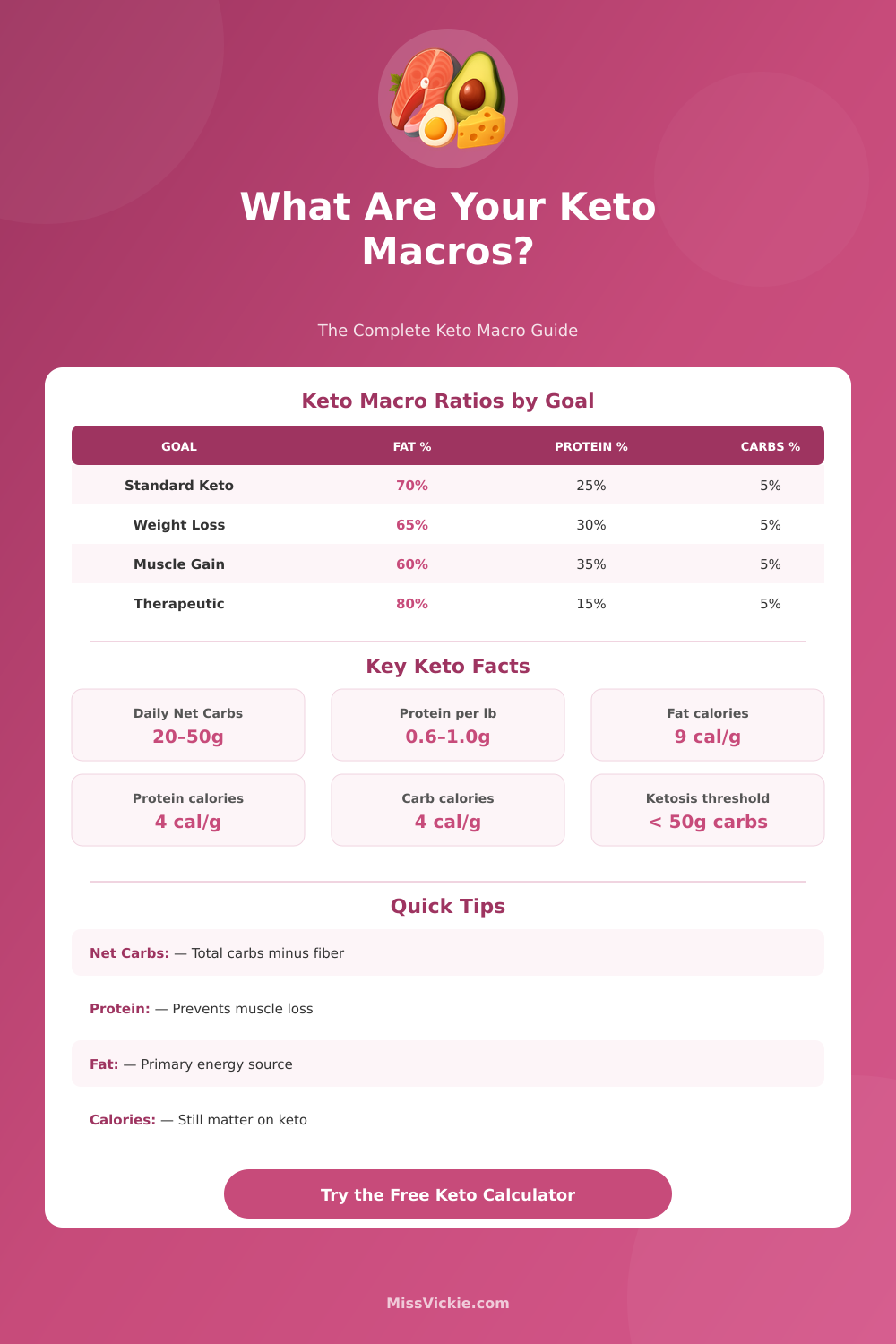
| Keto Protocol | Fat % | Protein % | Carbs % | Max Net Carbs/day | Best For |
|---|---|---|---|---|---|
| Standard (SKD) | 70–75% | 20–25% | 5% | 20–50g | General ketosis & fat loss |
| Targeted (TKD) | 65–70% | 20–25% | ~10% | 20–50g + 20g workout | Active gym-goers |
| Cyclical (CKD) | 70% | 20% | 5% / 50%+ | 50g keto / 400g+ refeed | Bodybuilders, athletes |
| Therapeutic | 80–90% | 10–15% | 2–5% | 20g strict | Medical / neurological |
| High Protein Keto | 60–65% | 30–35% | 5% | 20–50g | Muscle preservation |
| Food | Calories | Fat (g) | Protein (g) | Net Carbs (g) | Keto Rating |
|---|---|---|---|---|---|
| Avocado | 160 | 14.7 | 2.0 | 1.8 | ⭐⭐⭐⭐⭐ Excellent |
| Bacon (cooked) | 541 | 42.0 | 37.0 | 1.4 | ⭐⭐⭐⭐⭐ Excellent |
| Cheddar Cheese | 402 | 33.0 | 25.0 | 1.3 | ⭐⭐⭐⭐⭐ Excellent |
| Salmon (raw) | 208 | 13.0 | 20.0 | 0.0 | ⭐⭐⭐⭐⭐ Excellent |
| Chicken Breast | 165 | 3.6 | 31.0 | 0.0 | ⭐⭐⭐⭐ Good (low fat) |
| Broccoli | 34 | 0.4 | 2.8 | 4.0 | ⭐⭐⭐⭐ Good |
| Spinach | 23 | 0.4 | 2.9 | 1.4 | ⭐⭐⭐⭐⭐ Excellent |
| Eggs (whole) | 155 | 11.0 | 13.0 | 0.7 | ⭐⭐⭐⭐⭐ Excellent |
| Butter | 717 | 81.1 | 0.9 | 0.1 | ⭐⭐⭐⭐⭐ Excellent |
| Almonds | 579 | 49.9 | 21.2 | 3.7 | ⭐⭐⭐⭐ Good |
| Calorie Target | Fat (70%) | Protein (25%) | Carbs (5%) | Net Carbs |
|---|---|---|---|---|
| 1,200 kcal | 93g | 75g | 15g | 15g |
| 1,500 kcal | 117g | 94g | 19g | 19g |
| 1,800 kcal | 140g | 113g | 23g | 23g |
| 2,000 kcal | 156g | 125g | 25g | 25g |
| 2,200 kcal | 171g | 138g | 28g | 28g |
| 2,500 kcal | 194g | 156g | 31g | 31g |
| 3,000 kcal | 233g | 188g | 38g | 38g |
A Macro calculator helps to estimate the needs in Macro nutrients for a person according to their age, physical traits, level of activity and goals for weight. To use it simply enter your age, gender, height, weight, level of motion and goals, to receive a custom plan about Macro. Like this it removes the hard math from the task.
The computation depends mainly on the weight of the person and on the amount of calories, that one probably will burn daily.
How to Use a Macro Calculator
Everyday foods store three main Macro nutrients, that one also calls Macro nutrients. Calculators about Macro set the ideal mix of proteins, carbohydrates and fats for various goals of training. Whether one wants to lose weight, build muscles, improve the haelth or increase stamina, the tool gives a fitting food program with Macro, calories and portions, that is fitted to the body and to the goals.
Physical activity alone does not suffice to remove fat. To win muscles, you need to balance food with a bit of extra. Some Macro calculators are designed to control the entry of calories aiming for maximum increase of lean muscle.
Plans like pure bulking or lean bulking consist in gain of muscles, while one keeps the growth of body fat low in that phase.
Knowing the amount of body fat allows more exact results. A formula, that includes the lean body mass in the math, gives more reliable patterns. Basically know, how many muscle one wants to add and how many fat to remove during a week.
Such goals help to estimate the needed amounts of carbohydrates, proteins and fats.
Some calculators base on the Dietary Reference Intakes, that the Division of Health and Medicine of the National Academies of Sciences, Engineering and Medicine built. Those data reflect the newest scientific knowledge about food needs. Other resources also include calculators for TDEE, for PCOS, tools for BMI and for Keto, besides the Macro calculator.
There are apps that help to track all of that. Macrofactor maybe works more for newcomers, while RP Diet Coach better suits for serious planning of meals. Macrosfirst can estimate the size of portions, which makes it easy and fast to fit foods to the Macro.
Calculators about calories always have a bit of guessing, so eating a fixed sure number of calories and checking the balance for three weeks is a good method. If the weight does not change, one can adjust the calories by around ten percent and repeat the process.
Even hitting the Macro seventy to eighty percent of the time already can give great results. Knowing the numbers is only the first step. Tying a Macro calculator with a plan for meals or with a set of recipes, that one can easily follow, creates the reel change.
Some tools even make a custom meal plan based on the given Macro, with a list for buying food andrecipes for the whole week.