🍖 Cooking Time Per Pound Calculator
Enter your meat type, weight & doneness to get exact roasting times
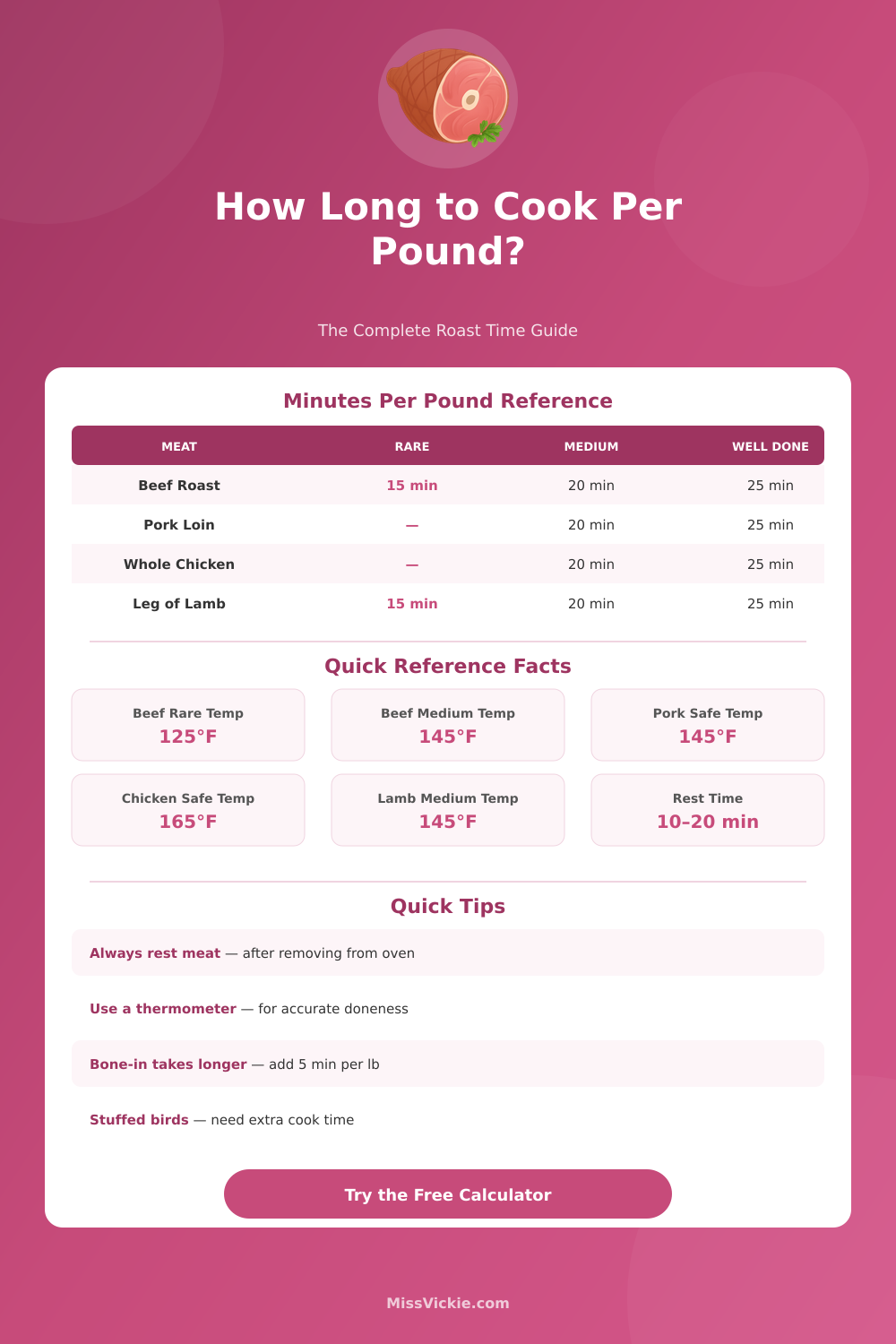
| Meat | Rare | Medium Rare | Medium | Well Done | Oven Temp |
|---|---|---|---|---|---|
| Beef Roast | 15 min/lb | 17 min/lb | 20 min/lb | 25 min/lb | 350°F |
| Pork Loin | — | — | 20 min/lb | 25 min/lb | 350°F |
| Whole Chicken | — | — | 20 min/lb | 25 min/lb | 350°F |
| Whole Turkey | — | — | 15 min/lb | 20 min/lb | 325°F |
| Leg of Lamb | 15 min/lb | 17 min/lb | 20 min/lb | 25 min/lb | 350°F |
| Bone-in Ham | — | — | 18 min/lb | 22 min/lb | 325°F |
| Pork Shoulder | — | — | — | 60 min/lb | 300°F |
| Whole Duck | — | — | 20 min/lb | 25 min/lb | 350°F |
| Veal Roast | — | — | 20 min/lb | 25 min/lb | 325°F |
| Pounds (lbs) | Kilograms (kg) | Grams (g) | Ounces (oz) |
|---|---|---|---|
| 1 lb | 0.45 kg | 454 g | 16 oz |
| 2 lbs | 0.91 kg | 907 g | 32 oz |
| 3 lbs | 1.36 kg | 1,361 g | 48 oz |
| 4 lbs | 1.81 kg | 1,814 g | 64 oz |
| 5 lbs | 2.27 kg | 2,268 g | 80 oz |
| 6 lbs | 2.72 kg | 2,722 g | 96 oz |
| 8 lbs | 3.63 kg | 3,629 g | 128 oz |
| 10 lbs | 4.54 kg | 4,536 g | 160 oz |
| 12 lbs | 5.44 kg | 5,443 g | 192 oz |
| 15 lbs | 6.80 kg | 6,804 g | 240 oz |
| 20 lbs | 9.07 kg | 9,072 g | 320 oz |
| Fahrenheit (°F) | Celsius (°C) | Gas Mark | Description |
|---|---|---|---|
| 300°F | 149°C | Gas 2 | Slow |
| 325°F | 163°C | Gas 3 | Moderately Slow |
| 350°F | 177°C | Gas 4 | Moderate (Standard) |
| 375°F | 191°C | Gas 5 | Moderately Hot |
| 400°F | 204°C | Gas 6 | Hot |
| 425°F | 218°C | Gas 7 | Very Hot |
| 450°F | 232°C | Gas 8 | Extremely Hot |
How long it takes to cook anything really depends on what happens in the kitchen. Maybe you only spend some minutes to mix together something simple, or you can sit and watch slow cooking for almost the whole day. Steak in a hot pan?
It can be ready in only five minutes. Add some vegetables to cook together with it, and the time grows to ten minutes. Pasta normally requires around eight minutes in hot water, and if you prepare sauce from leftovers the whole thing probably involves a solid twenty minutes in the kitchen.
How Long It Takes to Cook Food
There is also the other extreme. Pulled pork or brisket can require four to five hours of your time. Braised shanks cook in the range of two to three hours.
But pork schnitzel falls between the fastest foods that you can prepare, under ten minutes, no problem. The longest of everything? Well, that would be well processed pulled pork, that can last a whole day and half of cooking.
For everyday dinners during weekday nights, the most meals cook between twenty and thurty minutes. Everything becomes longer when you consider the prep work, chopping, slicing, all that vegetable cutting. Depending on what you work with, only handling the vegetables and the meat can involve more than an hour, sometimes even pushing to two hours.
So the whole process, from “I am hungry” to “the dinner is ready,” can stretch to fully four hours.
Meal prep changes the game though. I found that spending one or two hours during Sunday afternoon to prepare three or four days of meals can help very a lot during the week. You can split everything into meal-sized containers, freeze them, stick labels on them, and then each evening you only must reheat something that already is ready.
Here the main point: the times in recipes are not fixed. Heights cause problems with everything. The power of your oven affects the result.
Age of the oven, whether it truly was preheated, all that changes the time. Rather than always watching the clock, I have more luck with a meat thermometer and trusting your feelings. Notice how something smells, how it feels, how it looks.
For rare cooked meats, aim for around 120 degrees Fahrenheit inside, witch commonly happens after around thirty-five minutes of cooking.
The size of what you cook makes a big difference too. A roast that is eight inches thick requires four times more time than one that is only four inches. A three-pound brisket costs you around one hour, so about twenty minutes each pound on medium heat.
Thicker slices and more ingredients both stretch the time. If you halve a recipe, using a smaller pan, around half of the original size; you cankeep the cook time in the same range.
Sheet-pan dinners are surprisingly handy. At 200 degrees Celsius, mix everything with oil and spices, spread it in the pan and roast for twenty to thirty minutes, until everything browns nicely. Minimal hand work, but good results.
One thing to recall about baked rolls: shorter bake times can make them sink when they cool. Items that spend twenty minutes in the oven keep their form better than something that only has twelve.