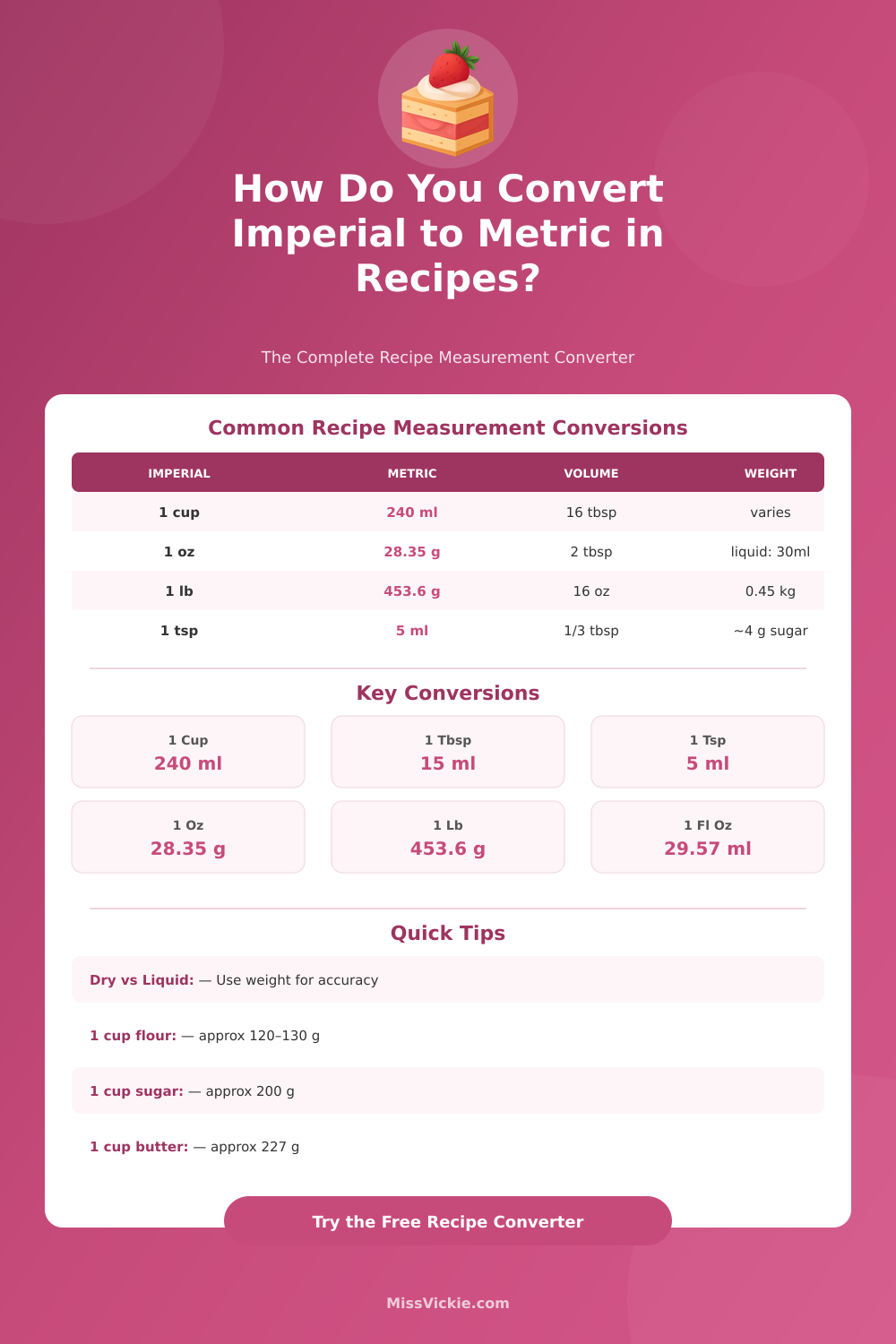
🧪 Recipe Imperial to Metric Converter
Instantly convert cups, ounces & tablespoons into grams, milliliters & kilograms
| Imperial Unit | Metric (Volume) | Equivalents | Notes |
|---|---|---|---|
| 1 Teaspoon (tsp) | 4.93 ml | 1/3 tbsp | ~5 ml rounded |
| 1 Tablespoon (tbsp) | 14.79 ml | 3 tsp | ~15 ml rounded |
| 1 Fluid Ounce (fl oz) | 29.57 ml | 2 tbsp | US fl oz |
| 1/4 Cup | 59.15 ml | 4 tbsp / 2 fl oz | Common baking unit |
| 1/3 Cup | 78.86 ml | 5 tbsp + 1 tsp | ~79 ml |
| 1/2 Cup | 118.29 ml | 8 tbsp / 4 fl oz | Common serving |
| 1 Cup | 236.59 ml | 16 tbsp / 8 fl oz | ~240 ml rounded |
| 1 Pint (US) | 473.18 ml | 2 cups | 0.473 L |
| 1 Quart (US) | 946.35 ml | 4 cups / 2 pints | 0.946 L |
| 1 Gallon (US) | 3785.41 ml | 16 cups / 4 quarts | 3.785 L |
| Imperial Unit | Grams (g) | Kilograms (kg) | Notes |
|---|---|---|---|
| 1 Ounce (oz) | 28.35 g | 0.028 kg | Avoirdupois oz |
| 2 Ounces | 56.70 g | 0.057 kg | |
| 4 Ounces (1/4 lb) | 113.40 g | 0.113 kg | |
| 8 Ounces (1/2 lb) | 226.80 g | 0.227 kg | |
| 12 Ounces (3/4 lb) | 340.19 g | 0.340 kg | |
| 1 Pound (lb) | 453.59 g | 0.454 kg | 16 oz |
| 2 Pounds | 907.18 g | 0.907 kg | |
| 5 Pounds | 2267.96 g | 2.268 kg |
| Ingredient | 1 Cup (g) | 1 Tbsp (g) | 1 Tsp (g) |
|---|---|---|---|
| Water | 237 g | 14.8 g | 4.9 g |
| Milk (whole) | 244 g | 15.3 g | 5.1 g |
| Oil (vegetable) | 218 g | 13.6 g | 4.5 g |
| All-Purpose Flour | 125 g | 7.8 g | 2.6 g |
| Bread Flour | 130 g | 8.1 g | 2.7 g |
| Cake Flour | 114 g | 7.1 g | 2.4 g |
| White Sugar (granulated) | 200 g | 12.5 g | 4.2 g |
| Brown Sugar (packed) | 220 g | 13.8 g | 4.6 g |
| Powdered Sugar | 120 g | 7.5 g | 2.5 g |
| Butter | 227 g | 14.2 g | 4.7 g |
| Rice (dry, uncooked) | 185 g | 11.6 g | 3.9 g |
| Table Salt | 292 g | 18.3 g | 6.1 g |
| Honey | 340 g | 21.3 g | 7.1 g |
| Cocoa Powder | 100 g | 6.3 g | 2.1 g |
| Rolled Oats | 90 g | 5.6 g | 1.9 g |
| Almond Flour | 96 g | 6.0 g | 2.0 g |
A Recipe converter is in short your assistant in the kitchen (it helps you multiply), share or scale recipes up and down according to the number of folks for that you cook. One commonly hears it called a Recipe scaler or serving sizer. That tool makes life easier when you must adapt the amounts of ingredients because you feed a whole group instead of only yourself.
Here is how it works at its base. The converting method divides the wanted servings by the original Recipe parts. Later you multiply every ingredient by that number to receive the fresh amounts.
How to Scale Recipes and Convert Measurements
Assume that the Recipe makes ten servings, but you require only four, that results in a factor of 0.4. When the Recipe requires three spoons of something, you will end with around 1.2 spoons after the calculation. After you finish the math, one can round those numbers to more practical measures, so that everything goes more smoothly in reality.
Double or halve recipes? This is the simple bit. You want double amount of flour?
It goes from one cup to two cups. For the half? Then half a cup is enough.
But here is the key, not everything goes this smooth, especially while baking. If you try to multiply a Recipe more than threefold, troubles usually come up. Here it helps to prepare several sets on separate occasions, which is the wiser way.
To count individual serving size, you simply divide the amounts of ingredients by the number of servings in the Recipe. For instance, if a Recipe for two folks requires one onion, each receives half of it.
Today there are many free online converters for recipes. Some allow you to enter a whole Recipe, and they immediately adapt all ingredients. The more advanced ones, powered by artificial intellect, seize the density of ingredients and exchange between American usual, British imperial and metric system without any effort.
You can add a link to a Recipe and only modify the serving number to have precise new measures. Others focus on converting between American and metric modes, according to what you have before.
There is also a phone app called Measury Recipe Converter, that you can download from the store of programs. Those resources handle even the most subtle recipes without big effort.
One good trick that really works is converting cup amounts to grams. For instance, many folks know that one cup of flour weighs around 150 grams, while one cup of sugar arrives to almost 200 grams. Because liquids in the kitchen weigh almost one gram each milliliter, turning cups and ounces to milliliters is fairly easy.
One ounce matches to around 30 milliliters. After you converted and printed your Recipe, you can note little corrections for future occasions, for instance, work the flour in cakes until it feels write.
Some converters also handle switching between cups, spoons and teaspoons in milliliters or liquid ounces. The main bonus is that you can scale and adapt all your measures in one step, settling every involved calculation in a moment. Using a kitchenscale for baking tends to give safer results than simply guessing cup amounts by eye.