🔄 Carb Cycling Macros Calculator
Calculate personalized high, moderate, low & no-carb day macros for fat loss or muscle gain
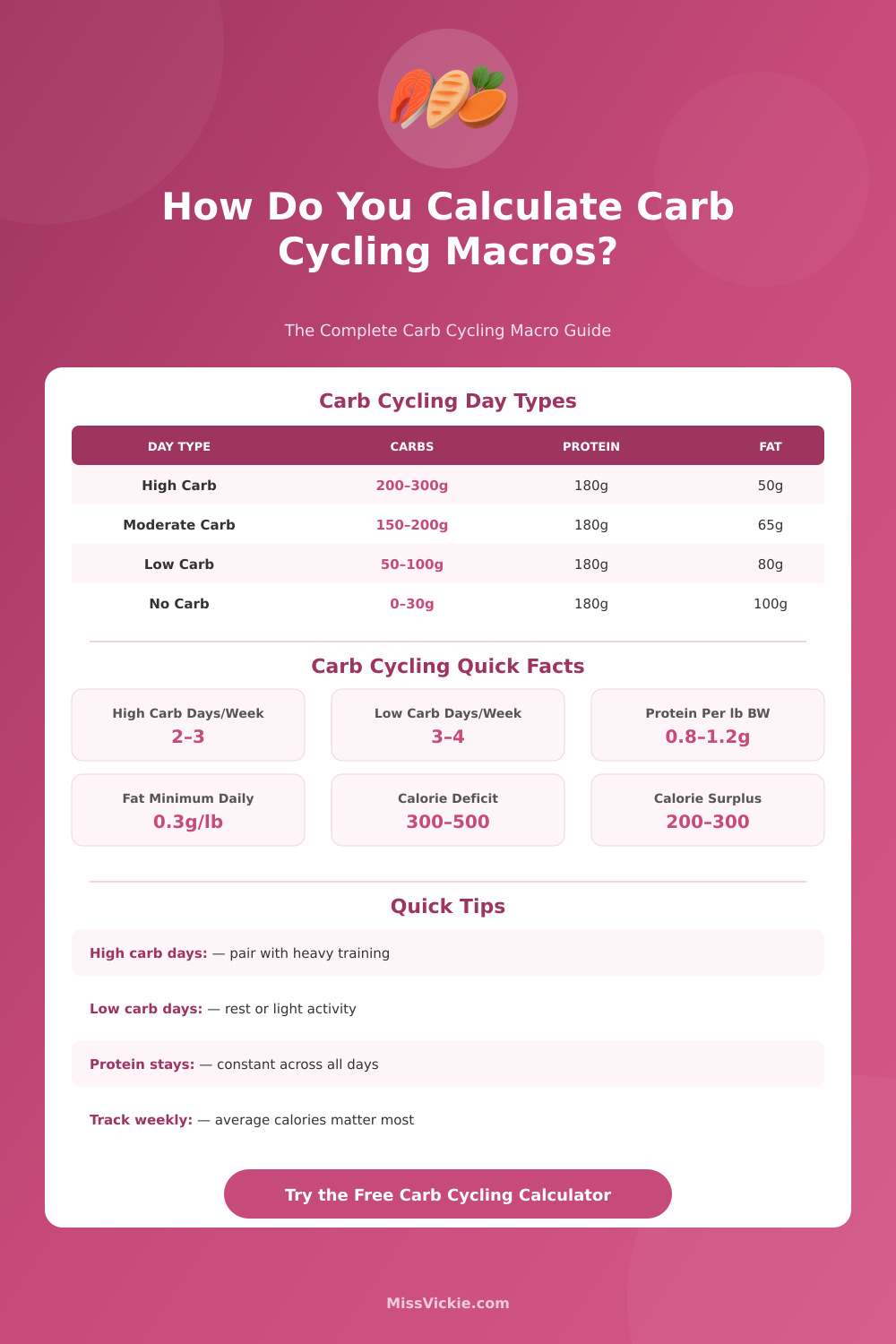
| Day Type | Carb Target | Protein Target | Fat Target | Best For |
|---|---|---|---|---|
| High Carb | 2.5–3.5g / lb BW | 0.8–1.0g / lb BW | 0.3–0.4g / lb BW | Heavy lifting, leg day, HIIT |
| Moderate Carb | 1.2–2.0g / lb BW | 1.0–1.2g / lb BW | 0.4–0.5g / lb BW | Moderate training days |
| Low Carb | 0.5–1.0g / lb BW | 1.0–1.2g / lb BW | 0.5–0.7g / lb BW | Light cardio, active recovery |
| No Carb | 0–30g total | 1.2–1.4g / lb BW | 0.7–0.9g / lb BW | Full rest days |
| Food | Serving Size | Carbs (g) | Calories | Glycemic Index |
|---|---|---|---|---|
| White Rice (cooked) | 1 cup (186g) | 53g | 242 | High (64–72) |
| Brown Rice (cooked) | 1 cup (195g) | 46g | 216 | Medium (50–55) |
| Oats (dry) | 1/2 cup (40g) | 27g | 150 | Low (55) |
| Sweet Potato | 1 medium (130g) | 26g | 112 | Medium (63) |
| Banana | 1 medium (118g) | 27g | 105 | Medium (51) |
| Bread (whole wheat) | 1 slice (28g) | 13g | 69 | Medium (69) |
| Pasta (cooked) | 1 cup (140g) | 43g | 220 | Low–Medium (50) |
| Quinoa (cooked) | 1 cup (185g) | 39g | 222 | Low (53) |
| Potato (baked) | 1 medium (173g) | 37g | 161 | High (85) |
| Lentils (cooked) | 1 cup (198g) | 40g | 230 | Low (32) |
| Pattern | High Days | Low Days | No-Carb Days | Best Goal |
|---|---|---|---|---|
| 3-3-1 | 3 | 3 | 1 | General fat loss |
| 2-4-1 | 2 | 4 | 1 | Aggressive cut |
| 3-2-2 | 3 | 2 | 2 (moderate) | Body recomposition |
| 4-3-0 | 4 | 3 | 0 | Lean muscle gain |
| 1-5-1 | 1 | 5 | 1 | Contest prep |
Carbohydrates, or simply carb called, are made up of sugar molecules. They form one of the three main foods in our everyday meal, together with proteins and fat. Those substances are made up of atoms of carbon, hydrogen and oxygen.
Carbohydrates should be part of your diet because they deliver the main energy to the body, especially for the brain.
What Are Carbohydrates and Why We Need Them
Carbohydrates appear in three main kinds: starch, fibers and sugars. During buying of packed foods, the word “total carbohydrates” on the label covers all those forms. Simple carbohydrates one can consider as sugars.
Fructose, for instance, is simple sugar in fruits and honey. Fructose with glucose create sucrose, that is the usual sugar powder in almost every kitchen. Foods with simple carbohydrates, as bread, cake, cakes or pasta, quickly braek down in sugar during digestion.
When one eats carbohydrates, the body breaks them into glucose, a kind of sugar. That raises the amount of glucose in the blood. Later the body uses this glucose as fuel to stay active whole day.
Simple carbohydrates in sweets already have their chains broken down, so they feel sweet. Consuming them, the blood sugar quickly goes upward, and the pancreas immediately sends much insulin, what causes fast descent of the sugar.
Carbohydrates help also in building of muscle protein and in various physical functions, as running of the mood. They matter for sports, that requires sudden strong motion, for instance run.
The best carbohydrates to eat come directly from plants. Grains, starchy vegetables and beans form good sources. It helps to eat whole grains, beans, vegetables and fruits, because they give fibers, vitamins, minerals and other plant foods.
Complex carbohydrates are the healthiest, because they have much fiber, vitamins and minerals, and they require more time to digest. Like this one stays full four a longer period.
Many store foods have too much extra carbohydrates and added sugars. Products as protein bars, shakes, sauces, nutty butters, yoghurt, plant-based meats, chia seeds and frozen dinners commonly belong to that group. The simpler carbohydrates one eats, the more one wants them.
Carbohydrates alone are not harmful. Too much of anything is bad. One serving of carbohydrates matches around 15 grams.
The amount of servings, that one requires for a meal, depends on age, weight, usual eating and physical movement. Typical macros are 45 to 60 grams each meal, what matches 3 to 4 servings. By comparing labels and watching serving sizes, onefinds the best products.
Low-carb diets limit carbohydrates from grains, starchy vegetables and fruits, while they stress foods rich in protein and fat. People with resistance to insulin commonly store glucose as body fat, hence low-carb and keto diets can work well, when one combines them with cutting of calories.