🛒 Monthly Grocery Budget Calculator
Estimate your ideal monthly grocery budget based on household size, diet type, and spending habits
| Age / Group | Thrifty | Low-Cost | Moderate | Liberal |
|---|---|---|---|---|
| Toddler (1–4 yrs) | $130 | $165 | $200 | $245 |
| Child (5–12 yrs) | $165 | $215 | $265 | $315 |
| Teen (13–17 yrs) | $205 | $265 | $325 | $395 |
| Adult Female (18–50) | $195 | $250 | $305 | $385 |
| Adult Male (18–50) | $240 | $310 | $380 | $470 |
| Adult Female (51–70) | $185 | $235 | $290 | $370 |
| Adult Male (51–70) | $225 | $285 | $350 | $440 |
| Senior Female (71+) | $175 | $225 | $275 | $345 |
| Senior Male (71+) | $210 | $265 | $325 | $410 |
| Food Category | % of Budget | Example for $600/mo | Notes |
|---|---|---|---|
| 🥩 Meat, Poultry & Fish | 22–28% | ~$150 | Highest cost category |
| 🥦 Fresh Produce | 15–20% | ~$105 | Seasonal saves money |
| 🧀 Dairy & Eggs | 10–14% | ~$72 | Milk, cheese, yogurt, eggs |
| 🍞 Grains & Bread | 8–12% | ~$60 | Rice, pasta, bread, cereals |
| 🥫 Pantry Staples | 8–10% | ~$54 | Oils, condiments, spices |
| 🥤 Beverages | 6–9% | ~$45 | Juice, coffee, tea, water |
| 🍪 Snacks & Sweets | 5–8% | ~$39 | Chips, cookies, candy |
| 🧊 Frozen & Prepared | 5–8% | ~$36 | Frozen meals, convenience |
| 🩹 Household & Personal | 8–12% | ~$66 | Cleaning, toiletries |
| Diet Type | Cost Multiplier | Reason | Savings Tip |
|---|---|---|---|
| Omnivore (Mixed) | 1.00x (baseline) | Standard USDA benchmark | Buy store-brand proteins |
| Vegetarian | 0.85x | Less expensive proteins (beans, tofu) | Buy dried legumes in bulk |
| Vegan | 0.80x | No meat or dairy — cheaper base | Focus on whole grains & legumes |
| Keto / Low-Carb | 1.20x | High meat, nuts, specialty items | Buy fatty cuts (cheaper per oz) |
| Gluten-Free | 1.25x | Specialty products cost more | Choose naturally GF foods |
| Mostly Organic | 1.35x | Organic premium 20–50% higher | Use Clean 15 / Dirty Dozen list |
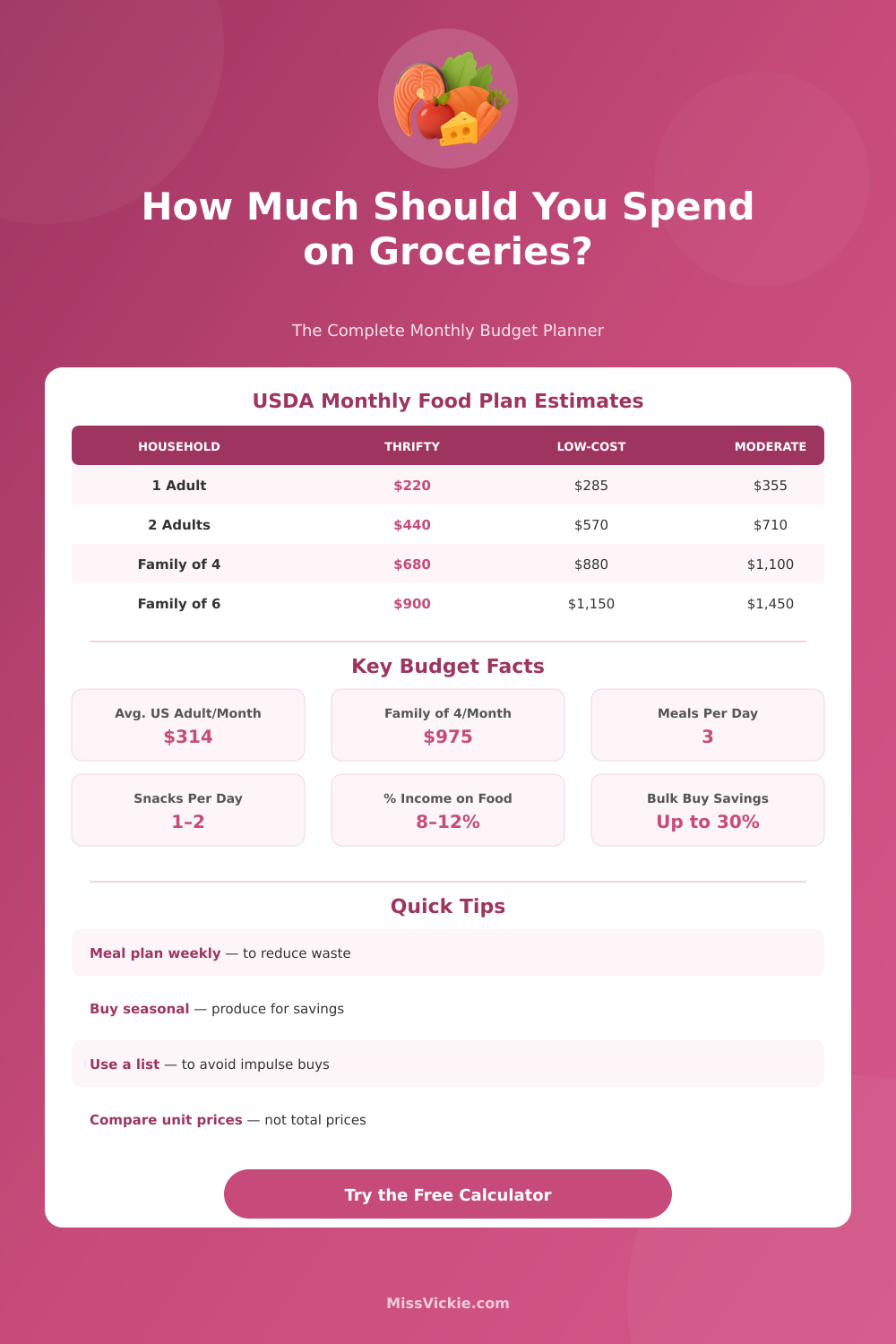
Learn to budget for foods could be the most useful money skill in that area. Most American families spend around 270 dollars each week for food and that gives a good base to start before fitting everything to your own situation. Good goals are to keep grocery costs around 12% of the income of your family.
Every month, the USDA puts out food plans, that show guessed costs for food based on four different levels of budget: thrifty, cheap, medium-cost and open. If you choose the thrifty option as a single person, you must plan between 57 and 78 dollars per week. During a month, that comes to something between 246 and 339 dollars, although it ranges based on your age and gender.
How to Budget for Food
For a family of four, the numbers grow a lot, the ratings of USDA between 1000 and 1600 dollars monthly. There are also online tools based on the cheap plan of USDA, that quickly give weekly targets, if you enter the size of your family, the gender mix and basic eating habits.
For a medium budget, a single adult man usually spends around 465 dollars monthly for food. A single adult woman commonly reaches more closely 392 dollars, more or less.
To get a real look at your budget habits, you must do more than one thinks. Say that you now spend 600 dollars monthly for food, but want to reach 400. Instead of a sudden change, better is a slow approach to adjust well.
In the first month aim for 500, in the second 450, and finally in teh third you reach the 400 dollar target. A budget that is too strict simply does not work for anyone.
Here is the main point of planning for meals: it right away stops quick buys. Plan your breakfasts, lunches and dinners for the week, then buy only what you truly need for them, to help keep your costs under control. Write a list from your meal plan and stick to it.
Cook in bigger amounts and freeze parts for single servings to stretch the value of your money. Buy fresh vegetables and fruits in season to truly save (otherwise use frozen), that works well. Processed or name brand products cost much more then making food from basic items.
Knowing what things truly cost per unit makes a big change. Watch for sales and stock up when prices drop, those are good moves. Most grocery stores show the price per unit on the label of the shelf, which makes it easy to compare different brands and packages.
Sometimes some little packages end up being more cheap than one large one.
budget friendly chains like Walmart, Costco and Aldi commonly help. Local grocery stores usually drop prices for products that are close to their sell date. Day old bread from the bakery could cost only one dollar instead of seven.
Help programs support poor families to stretch their grocery budget and reach healthy foodchoices. Recall: a budget is a ceiling, not a target to reach.