🏃 Marathon Carb-Loading Calculator
Calculate your precise carbohydrate targets for race week based on your weight, training load, and phase.
| Food | Serving Size | Carbs (g) | Notes |
|---|---|---|---|
| White Rice (cooked) | 1 cup (186g) | 45g | Excellent low-fiber choice |
| Pasta (cooked) | 1 cup (140g) | 43g | Classic carb-load staple |
| White Bread | 2 slices (60g) | 30g | Easy to digest |
| Banana | 1 medium (118g) | 27g | Potassium + fast carbs |
| Bagel (plain) | 1 large (105g) | 53g | High carb, low fiber |
| Sports Drink (32 oz) | 32 fl oz (946ml) | 56g | Easy to consume |
| Orange Juice | 1 cup (248ml) | 26g | Simple sugars, fast absorption |
| Pancakes (plain) | 3 medium (225g) | 60g | Good breakfast option |
| Boiled Potato (no skin) | 1 medium (150g) | 31g | Low fiber without skin |
| Energy Gel | 1 packet (32g) | 22g | For race morning top-up |
| White Crackers | 10 crackers (30g) | 22g | Light & portable |
| Honey | 1 tbsp (21g) | 17g | Pure fast-release sugar |
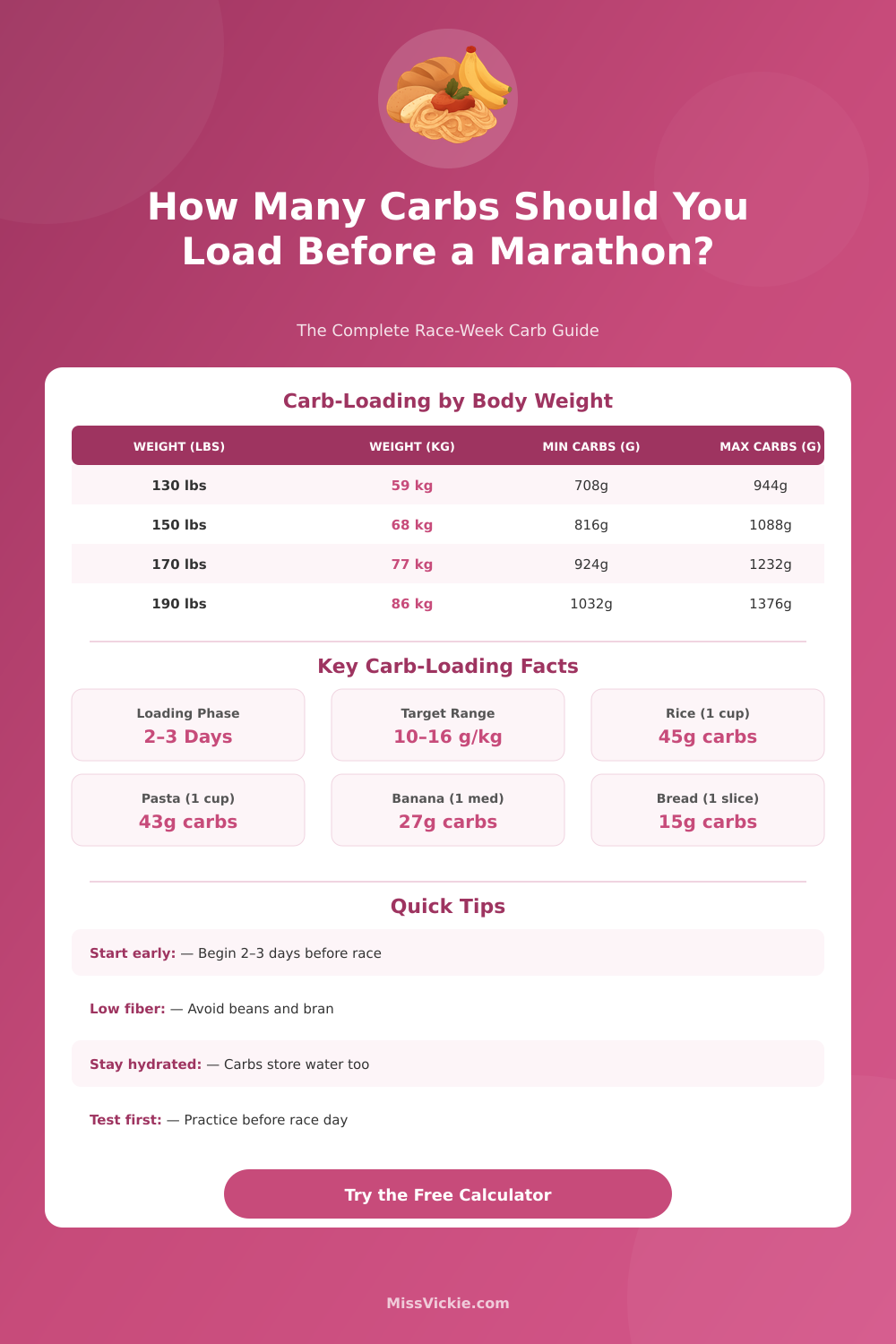
| Weight (lbs) | Weight (kg) | Min Daily Carbs (10g/kg) | Max Daily Carbs (12g/kg) |
|---|---|---|---|
| 110 lbs | 50 kg | 500g | 600g |
| 121 lbs | 55 kg | 550g | 660g |
| 132 lbs | 60 kg | 600g | 720g |
| 143 lbs | 65 kg | 650g | 780g |
| 154 lbs | 70 kg | 700g | 840g |
| 165 lbs | 75 kg | 750g | 900g |
| 176 lbs | 80 kg | 800g | 960g |
| 187 lbs | 85 kg | 850g | 1020g |
| 198 lbs | 90 kg | 900g | 1080g |
| 209 lbs | 95 kg | 950g | 1140g |
| 220 lbs | 100 kg | 1000g | 1200g |
| Timing | Carb Target | Intensity | Goal |
|---|---|---|---|
| 3 Days Before Race | 10–12 g/kg body weight | High | Start glycogen supercompensation |
| 2 Days Before Race | 10–12 g/kg body weight | High | Continue glycogen loading |
| 1 Day Before Race | 8–10 g/kg body weight | Moderate | Top off stores, reduce fiber |
| Race Morning (3-4 hrs) | 1–4 g/kg body weight | Moderate | Final top-up, familiar foods |
| Race Morning (1-2 hrs) | 1–2 g/kg body weight | Low | Quick absorbing carbs only |
| During Race (per hour) | 30–90 g/hour | Ongoing | Maintain blood glucose |
If you’re running a marathon carb-loading is a strategy that top athletes use to improve their output in long events. One commonly sees marathon runners and triathletes doing it before the main event. The main idea consists in filling the muscles with the maximum amount of stored energy before crossing the start line.
Those extra reserves in the body help you last, when the race becomes difficult in such marathon tests.
How to Carb-Load Before a Marathon
Imagine stored energy from carbohydrates, that your muscles save for later use. During exercise, your body burns it as fuel. Even so, there is something important: the brain uses up the stored energy from the reserves.
When those end, the body switches to other sources and starts breaking down protein and fat, which is much less efficient. Carb-loading gives you more time before that change, so you stay more energetic for longer time.
Usually, folks can last two to three hours of activity with the natural stored energy in their muscles. Carb-loading helps that a bit, but not too much. From my experience and notes, it can add around 10 to 15 percent of endurance.
Although that does not seem big, it feels huge, when you suffer in the 18th mile of a marathon.
The period for loading usually happens between 24 and 48 hours before the run. In that time, carbohydrates with high sugar rate and little fiber work best. Some athletes extend it to two or three days before.
The secret is not eating huge portions, but increasing the share of carbohydrates on the plate. For that, one reduces fat and protein, to free space for that energy.
Aim for around seven to eight grams of carbohydrates for every kilo of body mass, that seems to be the good amount. Honestly, it sounds harder then it really is. During the loading, aim for 70 to 80 percent of your calories to come from carbohydrates.
In practice, at every meal fill half of the plate with them, while protein takes a quarter for muscle repair, and the rest goes to carbohydrates.
White rice, noodles, pasta, potatoes and bread are good choices for this. They digest easily and do not add too much fat. Dried apricots and similar fruits give lots of carbohydrates without weight.
The classic method is pasta with garlic bread the evening before, simple, easy meal full of energy. Athletes avoid heavy foods with lots of fat or protein, because they load the stomach.
Here is good advice: carbohydrates attract water in your body. Every gram of stored energy brings three to four grams of water. So, increase your drinking during the loading to avoid bad feeling.
Some athletes feel a bit heavier after it because of that extra water. A little rest the day before helps to release that tension. Test carb-loading first in smaller events, so thatyour stomach gets used to it before the big day with bigger amounts.