🔧 Holley Carb Jet Size Calculator
Find the correct jet size for your engine — adjust for altitude, fuel type & air/fuel ratio
| Engine (ci) | Carb CFM | Primary Jet | Secondary Jet | Build Level |
|---|---|---|---|---|
| 283 ci | 500 CFM | #64 | #65 | Stock |
| 302 ci | 600 CFM | #66 | #68 | Street |
| 327 ci | 600 CFM | #68 | #70 | Street |
| 350 ci | 650 CFM | #70 | #72 | Street Perf. |
| 383 ci | 750 CFM | #72 | #74 | Street/Strip |
| 396 ci | 750 CFM | #72 | #73 | Street Perf. |
| 427 ci | 800 CFM | #74 | #76 | Street/Strip |
| 454 ci | 850 CFM | #76 | #78 | Street/Strip |
| 496 ci | 950 CFM | #78 | #80 | Race |
| 540 ci | 1050 CFM | #82 | #84 | Race |
| Jet # | Drill Size (in) | Drill Size (mm) | Flow Area (in²) |
|---|---|---|---|
| #60 | 0.0600 in | 1.524 mm | 0.00283 in² |
| #62 | 0.0620 in | 1.575 mm | 0.00302 in² |
| #64 | 0.0640 in | 1.626 mm | 0.00322 in² |
| #66 | 0.0660 in | 1.676 mm | 0.00342 in² |
| #68 | 0.0680 in | 1.727 mm | 0.00363 in² |
| #70 | 0.0700 in | 1.778 mm | 0.00385 in² |
| #72 | 0.0720 in | 1.829 mm | 0.00407 in² |
| #74 | 0.0740 in | 1.880 mm | 0.00430 in² |
| #76 | 0.0760 in | 1.930 mm | 0.00454 in² |
| #78 | 0.0780 in | 1.981 mm | 0.00478 in² |
| #80 | 0.0800 in | 2.032 mm | 0.00503 in² |
| #82 | 0.0820 in | 2.083 mm | 0.00528 in² |
| #84 | 0.0840 in | 2.134 mm | 0.00554 in² |
| Altitude (ft) | Altitude (m) | Jet Change | Direction |
|---|---|---|---|
| 0 – 1,999 ft | 0 – 609 m | 0 sizes | No change |
| 2,000 – 3,999 ft | 610 – 1,219 m | –1 size | Leaner |
| 4,000 – 5,999 ft | 1,220 – 1,828 m | –2 sizes | Leaner |
| 6,000 – 7,999 ft | 1,829 – 2,438 m | –3 sizes | Leaner |
| 8,000 – 9,999 ft | 2,439 – 3,047 m | –4 sizes | Leaner |
| 10,000+ ft | 3,048+ m | –5+ sizes | Leaner |
| Fuel Type | Stoich A/F | Jet Adjust vs. Gasoline | Notes |
|---|---|---|---|
| Regular Gasoline | 14.7:1 | Baseline | Standard reference |
| Premium Gasoline | 14.7:1 | 0 sizes | Same jet as regular |
| Race Fuel (110) | 14.7:1 | +0 to +2 | Slight enrichment |
| E10 (10% Ethanol) | 14.1:1 | +1 size | Slightly richer |
| E85 Ethanol | 9.8:1 | +18 to +24 | Much larger jets needed |
Holley carburetors has provided horsepower to classic car and hot rods over several decades. However, setting the jets to a correct size is crucial to teh engine’s performance. Using the wrong jet sizes can starve the engine of fuel or flood it with excess amounts of fuel, both of which can damage the engine or reduce it’s performance. The correct jet sizes depends on the engine, the carburetor, and the desired air/fuel ratio for the engine.
A holley carb jet size calculator make it easier for engine tuners to determine the proper jet sizes for a given engine. By inputting a few variables about the engine and the carburetor, the calculator can suggest the proper jet sizes that will maximize the engine’s performance. As shown in the calculator above, users can determine the proper jet size based off the engine’s displacement and the carburetor’s CFM rating.
Key Factors That Determine Holley Jet Sizing
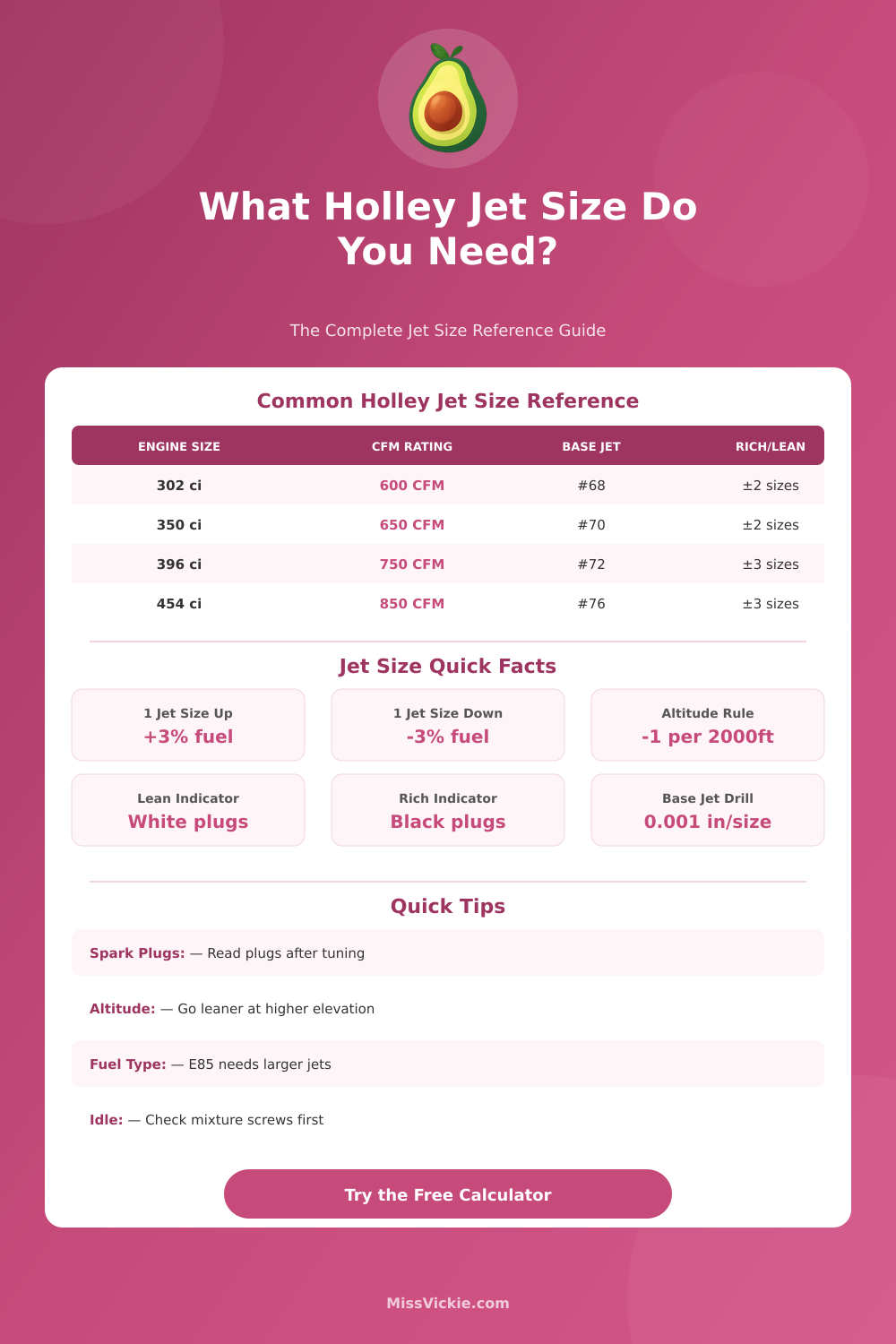
One of the most crucial factors that determine the correct size of the Holley carburetor jets is the size of the engines displacement. A large displacement engine, such as a 454-ci big block, will require larger jets than a small displacement engine, such as a 302-ci small block. Additionally, the CFM rating of the Holley carburetor will also play a crucial role in determining the correct jet sizes. A 650 CFM Holley carburetor for a 350-ci engine may use #70 jets as the primary jets. However, a 750 CFM Holley will require a change in the size of the primary jet to accommodate the increase in airflow.
The altitude of the engine’s location will also play a huge role in the sizing of the Holley carburetor jets. At higher altitudes, the air contains less oxygen for the engine’s combustion process. To account for this, you must use leaner jets that will require less fuel for combustion. At elevations of 5,000 feet above sea level, you will need to drop two sizes of jets from the sizes set for sea level. Additionally, if the fuel that is used in the engine is E85 fuel, you will have to increase the size of the jets dramatically since E85 fuel has a lower stoichiometric ratio then gasoline. E85 fuel has a stoichiometric ratio of 9.8:1 compared to gasoline’s 14.7:1 ratio. Thus, the jets for E85 fuel will need to be 20 sizes larger than those for gasoline.
The desired air/fuel ratio for the engine will play a crucial role in determining the proper size for the Holley carburetor’s jets. For street engine, an air/fuel ratio of 13.5:1 is ideal. However, race engines can have an air/fuel ratio of 12.8:1 at wide open throttle to maximize engine performance. Engines that are built for stock cars will have leaner fuel mixtures than engines specifically built to race cars.
The size of the engine’s primary jets will differ from its secondary jets. The secondary jets will be 2 to 4 sizes larger than the primary jets of a Holley carburetor. Furthermore, the color of the spark plugs can indicate if the engine’s jets are correctly sized. If the spark plugs have tan insulators, they are correctly sized for the engine. If the spark plugs have white ceramic insulators, the engine is running lean. If the spark plugs have black soot around their tips, the engine is running rich.
Pro tip: Change the jets in increments of one size if tuning the engine on the dyno, two sizes if tuning the car on the street, and recheck the spark plugs after a few heat cycles of the engine. Charts can help with the baseline settings for engine jet sizes. However, there is alot of additional variables that will play crucial roles in determining the exact size of the Holley carburetor jets for the engine. Tools like a Holley carburetor jet size calculator can get an engine closer to having the perfect air/fuel ratio for the engine. Once this is accomplished, the owner dont have to worry about jet sizes but can enjoy driving the car in perfect condition.