🔥 Calorie Calculator for Losing Weight
Enter your details to find your personalized daily calorie target & deficit
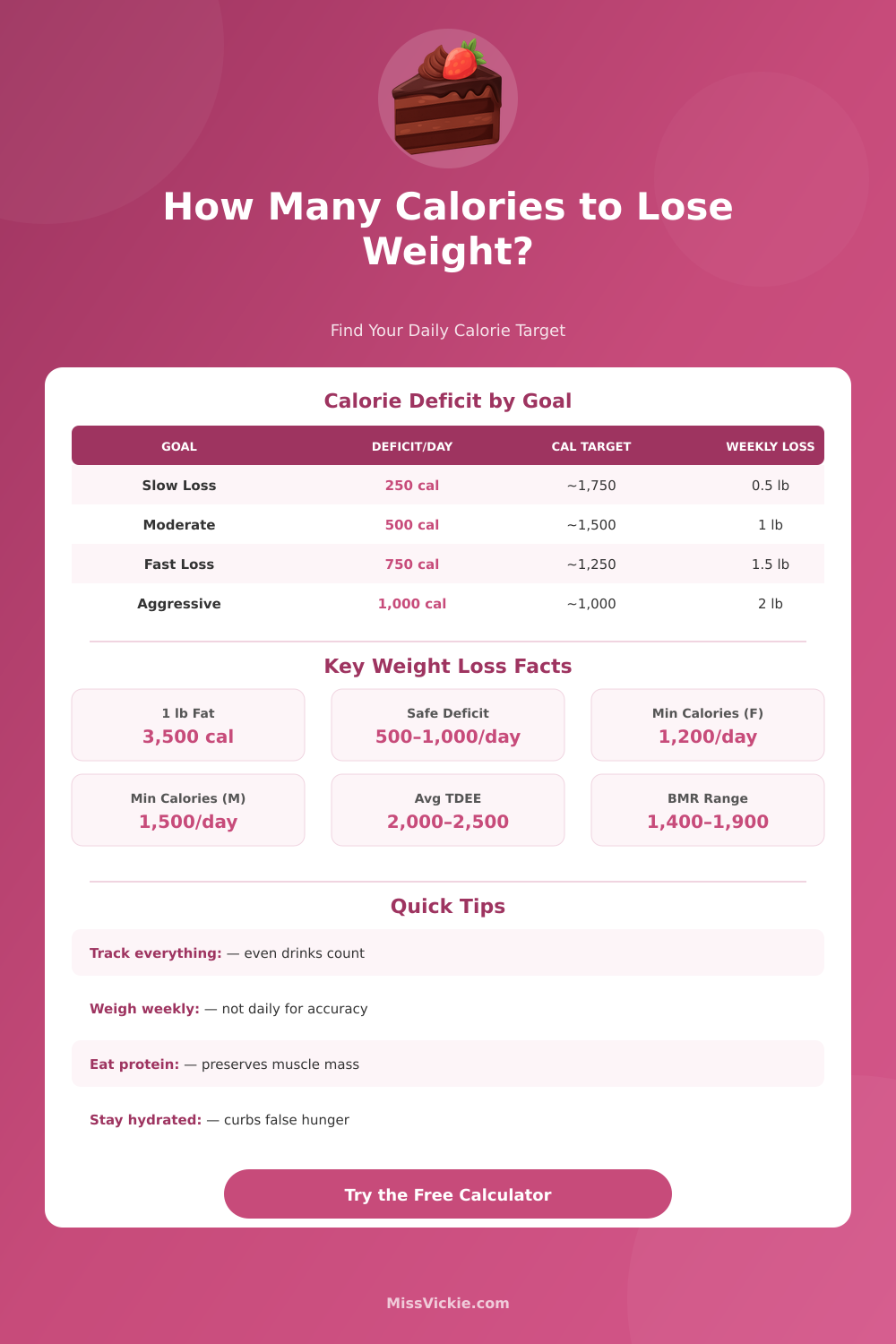
| Weekly Loss Goal | Daily Deficit | Approx. Daily Calories* | Recommended For |
|---|---|---|---|
| 0.25 lb / week | 125 cal/day | ~1,875 | Near goal weight, seniors |
| 0.5 lb / week | 250 cal/day | ~1,750 | Long-term sustainable loss |
| 1 lb / week | 500 cal/day | ~1,500 | Most people ✨ Sweet spot |
| 1.5 lbs / week | 750 cal/day | ~1,250 | Active individuals |
| 2 lbs / week | 1,000 cal/day | ~1,000 | Supervised / high BMI only |
*Based on average 2,000 cal TDEE. Your result will differ based on your personal TDEE.
| Activity Level | Multiplier | Example | Typical TDEE (F / M) |
|---|---|---|---|
| Sedentary | 1.2 | Office worker, no gym | 1,600 / 1,900 cal |
| Lightly Active | 1.375 | Walk daily, gym 1–2x/wk | 1,800 / 2,200 cal |
| Moderately Active | 1.55 | Gym 3–5x/wk | 2,000 / 2,500 cal |
| Very Active | 1.725 | Daily hard training | 2,300 / 2,800 cal |
| Extra Active | 1.9 | Athlete / labor job | 2,500 / 3,100 cal |
| Macronutrient | % of Calories | g per 1,500 cal | Why It Matters |
|---|---|---|---|
| Protein | 30–35% | 112–131g | Preserves muscle, high satiety |
| Carbohydrates | 35–45% | 131–169g | Energy, fibre, workouts |
| Fats | 20–30% | 33–50g | Hormones, fat-soluble vitamins |
| BMI Range | Category | Typical Deficit Strategy | Notes |
|---|---|---|---|
| Below 18.5 | Underweight | Not recommended | Focus on gaining, not losing |
| 18.5 – 24.9 | Normal Weight | 250 cal/day max | Body recomposition preferred |
| 25.0 – 29.9 | Overweight | 500 cal/day | 1 lb/week is ideal |
| 30.0 – 34.9 | Obese (Class I) | 500–750 cal/day | Medical guidance helpful |
| 35.0+ | Obese (Class II/III) | 750–1,000 cal/day | Consult healthcare provider |
Calorie calculator does the task pretty easy: it estimates how many calories your body needs daily to keep your present Weight, lose some pounds or add muscle. The main idea is to use your personal data about height, Weight and activity to build the daily target for calories. Whether you are woman or man, those tools provide solid base for controlling your intake.
Math under these calculators turns around Total Daily Energy Spending, or TDEE. This number roughly points how many calories your body burns during a day, when one considers exercise and daily motion. It starts by calculating your Basic Metabolic Rate, what your body uses at rest, then one multiplies it by an activity factor based on your lifestyle.
How Calorie Calculators Help You
When you have that number, you can add calories to grow Weight, lower them to lose Weight or simply leave it to keep state.
Most Calorie calculators are based on the Mifflin-St. Jeor equation, and for good reasno, studies show that it is more accurate than old methods like the Harris-Benedict formula. Some tools also use the NIH Body Weight Planner, that is based on real data from the National Institute about Diabetes, Digestive and Kidney Diseases.
Here is what makes them this useful for Weight control: they deliver a solid number that clearly points what you must eat over time.
Here is another kind of tools that deserves attention; those that stress daily advice about nutrition. They are based on Dietary Reference Intakes, that come from the Division of Health and Medicine of the National Academies of Sciences, Engineering and Medicine. It represents the newest scientific agreement about what your body truly needs.
Beyond simply guessing daily needs for calories, some tools help with recipes. You enter your ingredients and portions, and the calculator details the nutrition info. It points out calories, carbs, protein, fats, sodium and sugar, for one portion and for the hole recipe.
You also get a breakdown ingredient after ingredient, which is practical. Those tools accept cups, tablespoons, teaspoons, grams, units, any amount that you like.
Food Calorie databases form another great resource for research. Many use info from the National Food Database of USDA, which gives access to thousands of foods and items with full nutrition profiles. You find more than 37 000 foods and drinks listed, so finding what you want usually is not a problem.
Counting calories works as a good method to reach long-term Weight goals, especially if you combine it with regular exercises and wise eating habits. Tools for tracking tend to be good motivation, because they allow you to check progress whenever you want and keepan eye on the target. One good plus: if you change size of portions, many tools automatically count all nutrition values for you.