🥚 Hard Boiled Egg Protein Calculator
Calculate protein, calories & full nutrition for any number of eggs
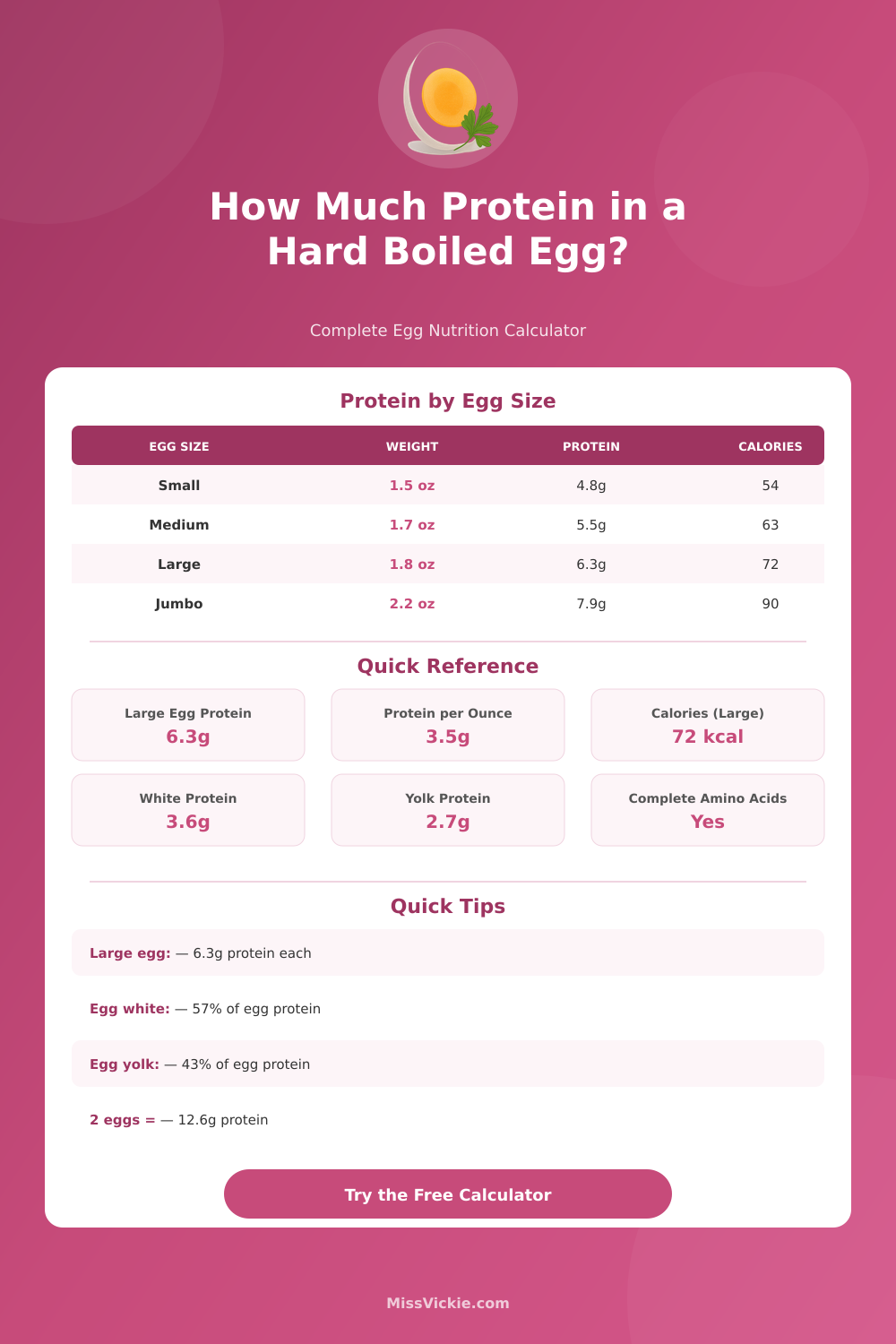
| Egg Size | Weight (oz) | Weight (g) | Protein (g) | Calories |
|---|---|---|---|---|
| Peewee | 1.25 | 35 | 4.0 | 51 |
| Small | 1.5 | 43 | 4.8 | 54 |
| Medium | 1.7 | 49 | 5.5 | 63 |
| Large | 1.8 | 50 | 6.3 | 72 |
| Extra Large | 2.0 | 56 | 7.0 | 80 |
| Jumbo | 2.2 | 63 | 7.9 | 90 |
| Component | Weight (g) | Protein (g) | Calories | Fat (g) |
|---|---|---|---|---|
| Whole Egg | 50 | 6.3 | 72 | 4.8 |
| Egg White | 33 | 3.6 | 17 | 0.1 |
| Egg Yolk | 17 | 2.7 | 55 | 4.5 |
| Number of Eggs | Protein (g) | Calories | Total Weight (oz) | Total Weight (g) |
|---|---|---|---|---|
| 1 Egg | 6.3 | 72 | 1.8 | 50 |
| 2 Eggs | 12.6 | 144 | 3.5 | 100 |
| 3 Eggs | 18.9 | 216 | 5.3 | 150 |
| 4 Eggs | 25.2 | 288 | 7.1 | 200 |
| 6 Eggs | 37.8 | 432 | 10.6 | 300 |
| 12 Eggs | 75.6 | 864 | 21.2 | 600 |
| Amino Acid | Amount (mg) | % Daily Value | Essential? |
|---|---|---|---|
| Leucine | 538 | 16% | Yes |
| Lysine | 452 | 13% | Yes |
| Valine | 428 | 17% | Yes |
| Isoleucine | 341 | 17% | Yes |
| Phenylalanine | 340 | 13% | Yes |
| Threonine | 310 | 15% | Yes |
| Histidine | 153 | 11% | Yes |
| Methionine | 196 | 18% | Yes |
| Tryptophan | 84 | 15% | Yes |
Hardly boiled eggs seems something simple and easy but pulling them off perfectly? Here where everything becomes tricky. Probably you have failed and found the white half with the shell or the yolk cracking, that becomes that ugly gray green ring instead of bright yellow.
Perfecting the method requires a bit of practice and some patience.
How to Make Perfect Hard-Boiled Eggs
There are several different ways to prepare eggs in their shells. The stovetop method is the most used, naturally, even so you can use your oven or pressure cooker if you want uniform cooking. For the oven way, around 325°F during 25 until 30 minutes usually give reliable results.
Regardless of the chosen method, one point: cool the eggs immediately in iced water soon after the cook.
The stovetop method has some variations, that are worth knowing. One of them is laying the eggs in cold water, turn the warming to maximum until boiling, later set the time for 7 until 10 minutes according to the wanted softness or firmness of the yolk. Leave the cover on and lower the flame to medium while they cook.
There is also the case, when one puts eggs directly in already very hot water, later cook during 8 until 11 minutes. After 8 minutes the yolk stays creamy inside, while 11 minutes ensure fully firm yolk without chalky look. Some folks insist on bringing the water to rough boiling only one minute, later add the eggs and leave them rest in the heat during 14 minutes.
That final method entirely avoids the green-ring problem.
That gray-green ring, that occasionally shows? It comes from sulphur in the yolk, that reacts with hydrogen sulphide in the white. Usually the cause is overcooking, although water rich in iron also can create it.
Use filtered water and gentle warming helps too keep it away. Add a bit of vinegar in the cooking water to stop eggs from spilling if they crack during the process.
Here something unlikely: older eggs shed more easily than entirely fresh ones. Those, that sat in your refrigerator during a week or two, are the ideal. After cooking, soak them in iced water and give gentle taps to help water enter under the shell.
Peeling while they yet are a bit warm also eases the job.
From a nutritious viewpoint, hardly boiled eggs deliver almost 6 grams of protein each unit. They have the whole range of amino acids, what makes them a good complete protein source. One finds here vitamin D, zinc and calcium, together with almost all B-vitamins.
One big egg stores around 73 calories and 5 grams of fat entirely.
When one eats them, diced hardly boiled eggs shine in salads typically Cobb’s, cut on avocado toast or mixed in tuna salad for richer texture and cream. Simple sandwich with hardly boiled egg, mayo, cut cheese, salt and pepper on roasted bread hits otherwise. Or put them in brine for fast pickled eggs with bitter taste.
Cooking thembefore saves time for easy work breakfasts with toast and coffee.