🌭 Sausage Protein Calculator
Calculate protein content by sausage type, serving size & number of servings
| Sausage Type | Link Weight | Protein / Link | Calories / Link |
|---|---|---|---|
| Pork Breakfast Link | 28g (1 oz) | 5g | 81 |
| Pork Breakfast Patty | 38g (1.3 oz) | 5g | 92 |
| Bratwurst | 85g (3 oz) | 12g | 256 |
| Italian Sausage | 100g (3.5 oz) | 17g | 268 |
| Chicken Sausage | 85g (3 oz) | 16g | 146 |
| Turkey Sausage | 85g (3 oz) | 15g | 144 |
| Kielbasa | 56g (2 oz)* | 8g | 152 |
| Chorizo (Mexican) | 56g (2 oz)* | 9g | 129 |
| Andouille | 100g (3.5 oz) | 17g | 250 |
| Vienna Sausage (canned) | 16g (0.6 oz) | 1.6g | 37 |
| Beef Smoked Sausage | 85g (3 oz) | 12g | 249 |
| Plant-Based / Veggie | 76g (2.7 oz) | 16g | 170 |
*Kielbasa and chorizo are often sold in longer ropes; 2 oz is a common single-serving slice.
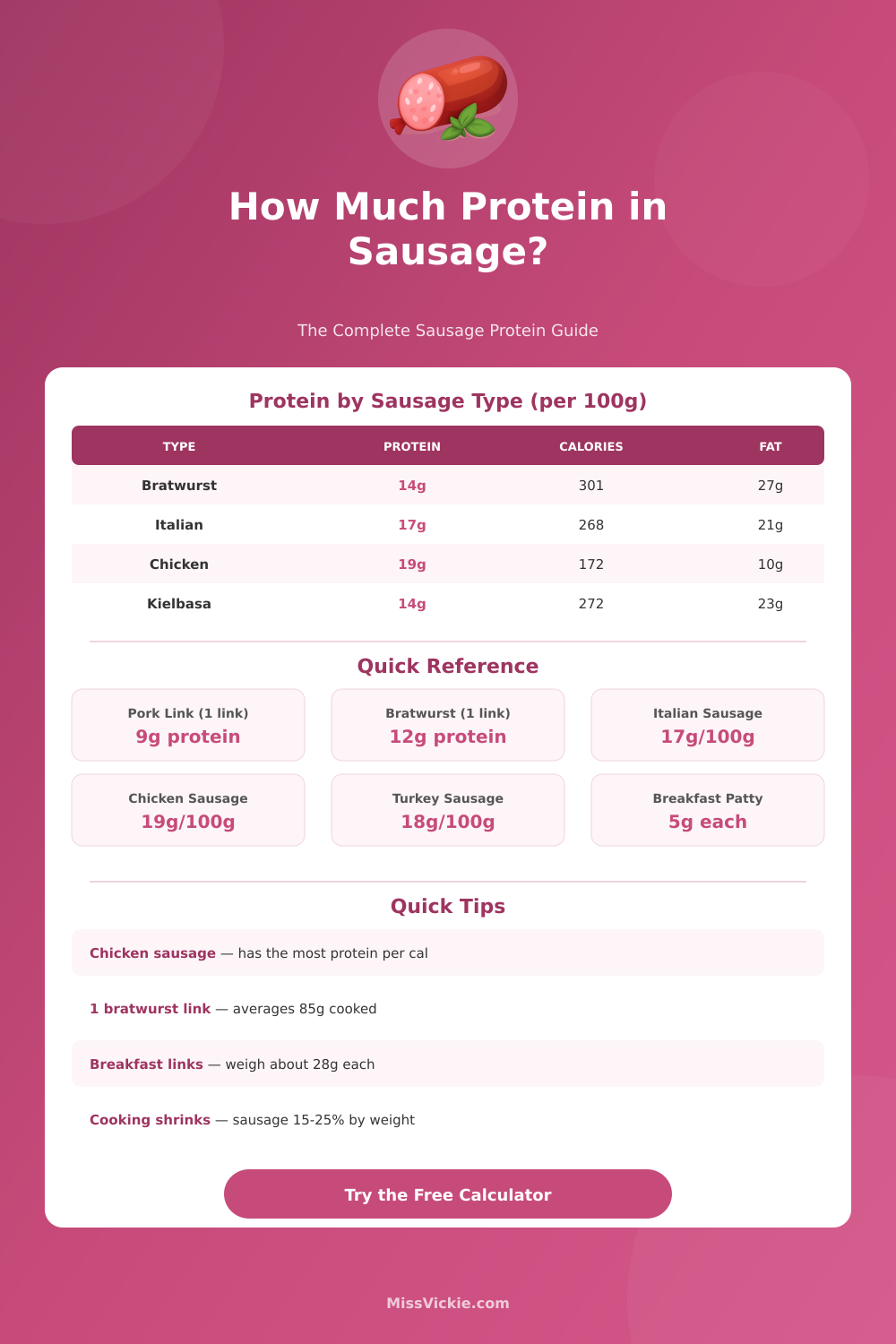
| Type | Calories | Protein | Fat | Carbs |
|---|---|---|---|---|
| Pork Breakfast Link | 289 | 18g | 23g | 1g |
| Pork Breakfast Patty | 242 | 14g | 20g | 1g |
| Bratwurst | 301 | 14g | 27g | 2g |
| Italian Sausage (Pork) | 268 | 17g | 21g | 2g |
| Chicken Sausage | 172 | 19g | 10g | 1g |
| Turkey Sausage | 169 | 18g | 10g | 1g |
| Kielbasa (Polish) | 272 | 14g | 23g | 3g |
| Chorizo (Mexican) | 231 | 16g | 18g | 1g |
| Andouille | 250 | 17g | 20g | 1g |
| Vienna Sausage (canned) | 230 | 10g | 20g | 2g |
| Beef Smoked Sausage | 293 | 14g | 26g | 1g |
| Plant-Based / Veggie | 224 | 21g | 13g | 5g |
| Sausage Type | Raw Weight | Cooked Yield | Weight Loss |
|---|---|---|---|
| Pork Breakfast Link | 100g | 78g | 22% |
| Bratwurst | 100g | 80g | 20% |
| Italian Sausage | 100g | 76g | 24% |
| Chicken Sausage | 100g | 85g | 15% |
| Turkey Sausage | 100g | 84g | 16% |
| Kielbasa (pre-smoked) | 100g | 92g | 8% |
| Chorizo (Mexican) | 100g | 72g | 28% |
| Andouille | 100g | 82g | 18% |
| Beef Smoked Sausage | 100g | 88g | 12% |
| Plant-Based / Veggie | 100g | 90g | 10% |
| Serving Context | Weight (Cooked) | Approx. Links | Protein Range |
|---|---|---|---|
| Breakfast side (small) | 56g / 2 oz | 2 small links | 8–10g |
| Breakfast main | 85g / 3 oz | 3 small links | 13–16g |
| Lunch / Dinner (1 sausage) | 85–112g / 3–4 oz | 1 large link | 12–19g |
| Hearty dinner (2 sausages) | 170–224g / 6–8 oz | 2 large links | 24–38g |
| Buffet / appetizer portion | 42g / 1.5 oz | 2–3 bites / slices | 6–8g |
| Kids portion | 42–56g / 1.5–2 oz | 1–2 small links | 5–8g |
Sausage is made up of ground meat enclosed in a casing, here the mainstream idea. Usually it is made from pig beef or chicken, although almost any kind of meat works. The mix gets taste by means of salt and spices, sometimes with bread or grains as fillers.
If some mention Sausage as a group, it means everything that is in a tube or skin done from Protein. Pork, beef, chicken, game, everything falls under that category.
What Is Sausage and How to Cook It
Ground meat in casings not only tastes good, it is also practical. Before, it helped to use leftover meat during animal slaughter. The salt in Sausage acted as a preservative, and local herbs or spices were mixed in it.
That made sense then, and truly, it still does today.
The variety here can get silly. There are sweet kinds, spicy, chorizo, fennel Sausage, apple Sausage, Italian types, Chinese Sausage and German bratwurst or knockwurst. Makers mix chicken with pig or combine anything alone.
Later everything becomes unusual in a good sense, venison Sausage with berries and Merlot-wine sounds nice (and apparently it is). Or smoked Cajun cranberry. Even more special?
Sea and pork mixes with lobsters, shrimps, scallops ore fish go well together. The creativity lasts.
Home Sausage making is not only talk (many truly do it). Breakfast Sausage works for a start, because it is simple and useful. The advantage?
If the casings or form fails, simply turn the skin away and form the meat into patties. Because breakfast Sausage does not need drying as some kinds, you can fry it soon or keep in a freezer for later.
Most commonly you find breakfast Sausage as links or patties beside eggs and toast. In Southeast United States, one uses it otherwise, little Sausage becomes a thick sauce on biscuits. Here is the whole custom below.
Good Sausage depends on some mainstream elements: the meat itself, moisture (from fat usually) and kind of filler. Quality changes a lot. Cheap brands use little meat, lots of fillers and chemicals.
Better ones flip that, mainly real meat with a bit of extras. Big contrast.
But here is the spot: Sausage must not be your only Protein. Whatever the base… Pig, beef, lamb, chicken, fish, cook it fully before you eat.
Use a thermometer for meat at 71°C as minimum. That is not up for debate.
Sausage can be cheap. In many stores it costs around two dollars per pound, sometimes even less. If you drop the casing and use it as ground beef (that costs around five dollars per pound), you save good money.
Package amounts differ more than one thinks. A normal bratwurst package stores five pieces and weighs about 170 grams. Hot dogs range from six to ten in the same 170-gram package.
Vienna Sausage are small; around seven in a 130-gram tin. Some links, tied by hand, give around three per pound. Each weighs almost 140 grams, so the serving tip is one andhalf links each person.
Grilling of Sausage brings challenges. Casings help to keep it together. Without them, the meat falls apart before cooking.
Rolling Sausage in wrap and twisting the ends seems clever, but commonly results in too thick products. Those details are small, but they matter during home Sausage making.