🍜 Dashi for Miso Soup Calculator
Calculate exact dashi, miso paste, and ingredient amounts for perfect miso soup
| Dashi Type | Kombu (per 4 cups) | Bonito (per 4 cups) | Other (per 4 cups) |
|---|---|---|---|
| Awase (Kombu + Bonito) | 10 g / 0.35 oz | 15 g / 0.53 oz | — |
| Katsuo (Bonito Only) | — | 20 g / 0.7 oz | — |
| Kombu (Vegetarian) | 15 g / 0.53 oz | — | — |
| Iriko (Dried Sardine) | 5 g / 0.18 oz | — | 20 g sardines |
| Shiitake (Vegan) | 10 g / 0.35 oz | — | 15 g shiitake |
| Instant (Hon-dashi) | — | — | 2 tsp granules |
| Strength | Miso per Cup Dashi | Miso per 4 Cups | Sodium Level |
|---|---|---|---|
| Light (Side) | 2 tsp / 12 g | 2.5 tbsp / 48 g | Lower |
| Regular | 1 tbsp / 18 g | 4 tbsp / 72 g | Medium |
| Rich (Main) | 1.5 tbsp / 24 g | 6 tbsp / 96 g | Higher |
| Ingredient | Per Bowl (Imperial) | Per Bowl (Metric) | Notes |
|---|---|---|---|
| Tofu (silken/soft) | 2 oz | 56 g | Cut into 1 cm cubes |
| Wakame (dried) | 1 tsp | 1 g | Expands 10x in water |
| Green Onion | 1 tbsp | 6 g | Thinly sliced |
| Enoki Mushrooms | 0.5 oz | 15 g | Trimmed, separated |
| Abura-age (fried tofu) | 0.5 piece | 15 g | Sliced into strips |
| Clams (asari) | 4–5 pieces | 50 g | Well scrubbed |
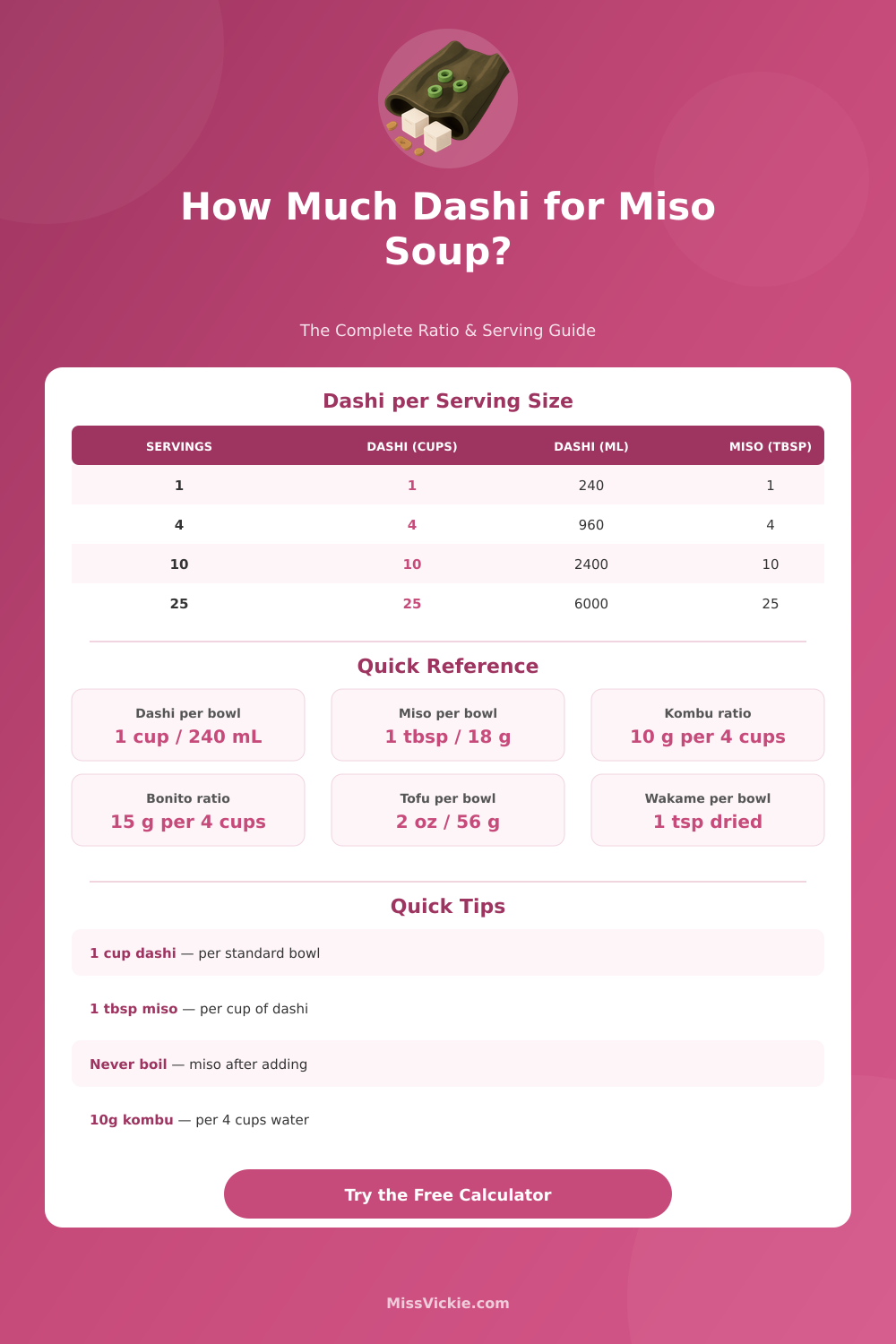
| Servings | Dashi (cups) | Dashi (mL) | Miso (tbsp / g) |
|---|---|---|---|
| 1 | 1 | 240 | 1 / 18 |
| 4 | 4 | 960 | 4 / 72 |
| 8 | 8 | 1,920 | 8 / 144 |
| 10 | 10 | 2,400 | 10 / 180 |
| 15 | 15 | 3,600 | 15 / 270 |
| 25 | 25 | 6,000 | 25 / 450 |
| 50 | 50 | 12,000 | 50 / 900 |
| 100 | 100 | 24,000 | 100 / 1,800 |
Note: The information in this article base on actual experience and changes of home cooks and fans about foods.
Dashi involve central place in Japanese cooking; it forms one of those basic elements, that gives right taste to everything else. This clear, but deeply delicious broth backs dishes like Miso Soup, udon, soba, egg custard and a mix of slowly cooked plates and sauces. Truly, many Japanese foods simply taste flat without it.
What is Dashi and How to Make It
One prepares the broth by means of dip of kelp (dried seaweed) and katsuobushi (dried, fermented tuna) in water. When those two ingredients meet they create delicious base, that answers for everything since simple bowl of Miso Soup until almost still steamed cake. In its essence, Dashi require only three parts: water, kelp and usually some kind of dried seafood, most commonly shaved dried-smoked bonito.
Dashi have several versions. The most known matches bonito with kelp. On the other hand, one can add other elements like shellfish, and some modes use only bonito.
The word Dashi self only point to stock in Japanese, so it is broad term, that covers whole series of ways to prepare it.
Describe Dashi from scratch are not entirely hard. Basic variant combines kelp and katsuobushi with water to create umami-full broth with real depth. Simple recipe requires only three ingredients.
For instance, start by means of dip of the kelp in water, later warm it slowly until boiling point; boiling it too fast will hurt the target. When the water a bit darkens, you almost done. If it two jumps, wash the kelp before dip to remove part of that white powder on the surface.
Here add the katsuobushi and leave it fall to the bottom, later filter everything through fine mesh strainer and you have liquid fortune.
Grate self the bonito and prepare Dashi by hand gives better taste than ready bonito or instant Dashi packets. It values the effort, but warning: you will stay with a bit of leftover stock.
Not every fans insist about making from scratch, even so. The fastest mode is use powdered Dashi like Hondashi, that works as a stock cube. Simply add it in your cook or dissolve in water for fast Dashi soup.
Japanese Dashi powders commonly give rich, pure umami and tie real soups, noodles and everyday plates in moments. Dashi packets form other option, and one bag usually works for around two until three servings. According to the desire about strength, one spoon of powder can prepare from three until six cups.
Here something to recall: many Dashi powders carry MSG. If that bothers you, search version without MSG in the store. Or simply skip the powder and prepare Dashi from scratch to escape the whole thing.
One can range the strength of your Dashi. Strong Dashi works when it must be the main taste. Weak Dashi works, when salt already comes from other parts of the plate.
Dashi splits in two main flavor sides: salt, smoke and sea notes on one side, and umami on the other. The first usually come from katsuobushi or niboshi, while kelp gives almost every umami.
Dashi self does not have too much of its own taste. But when it enters a plate, it greatly strengthens the set. It brings out the delicious quality called umami.
The broth serves base for Miso Soup, clear broths, noodle soups and crowds of slowly cooked liquids. One mixes it also in batters for grilled foods like okonomiyaki (that delicious Japanese pancake). Prepare okonomiyaki are easy and cheap.
You truly only require cabbage, thin strips of pork belly or bacon, Dashi and okonomiyaki sauce.
Miso Soup ranks between the most basic uses of Dashi. In traditional Japanese meals, rice and Miso Soup almost does not split. The ingredients stay minimal, with Dashi as anchor for everything.
Exist also recipes based on Dashi for every season: spring, summer, autumn and winter. The broth even can be topped by means of spurt of freshlyroasted sesame seed, especially during cold weather.