🎯 Yeast Per Gallon of Wine Calculator
Calculate the exact yeast dosage for your homebrew wine, mead, or cider
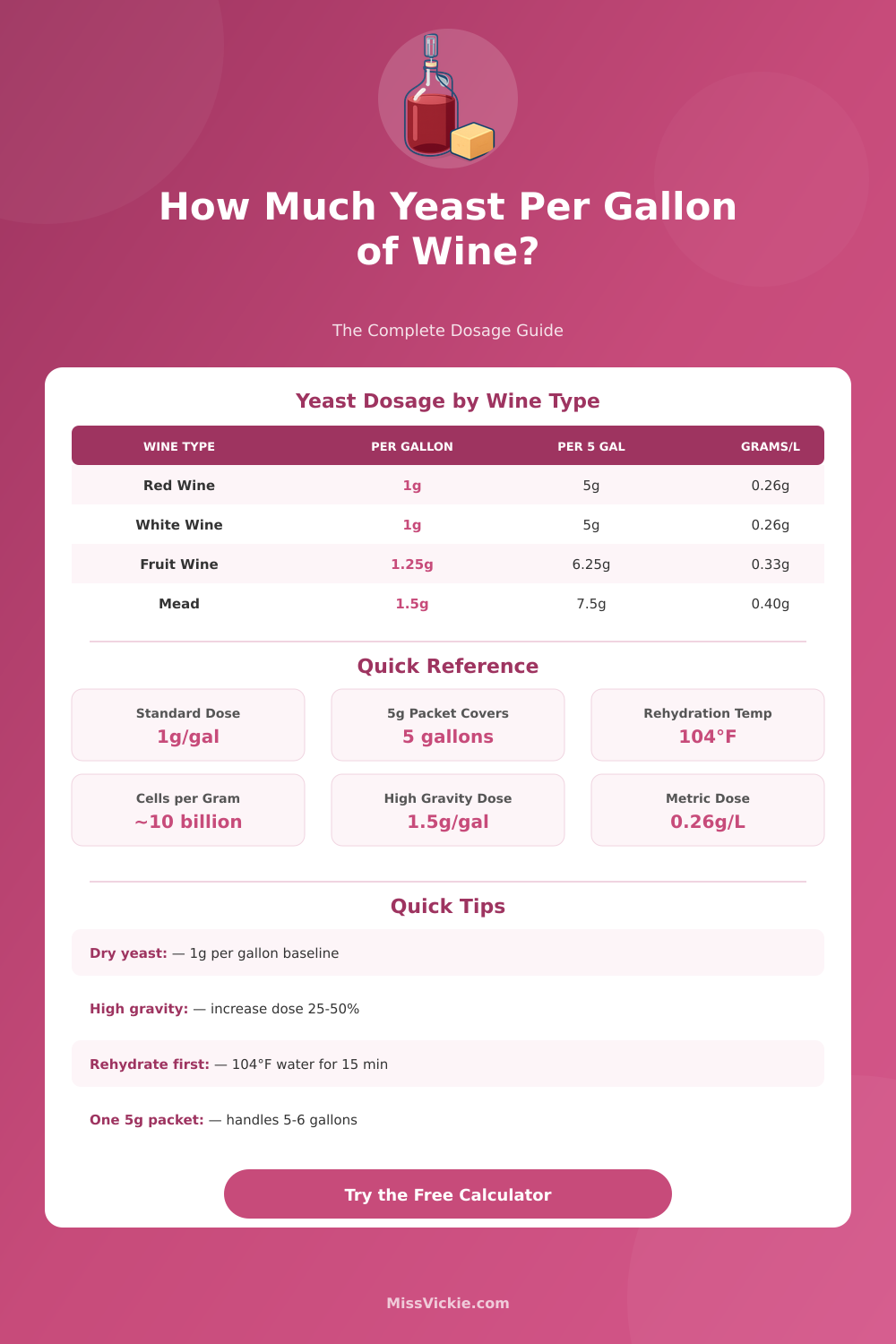
| Wine Type | Dry Yeast / Gal | Dry Yeast / Liter | Liquid Yeast / Gal |
|---|---|---|---|
| Red Wine | 1.0 g | 0.26 g | 35 mL |
| White Wine | 1.0 g | 0.26 g | 35 mL |
| Rosé | 1.0 g | 0.26 g | 35 mL |
| Fruit Wine | 1.25 g | 0.33 g | 40 mL |
| Mead (Normal OG) | 1.25 g | 0.33 g | 40 mL |
| Mead (High OG) | 1.5 – 2.0 g | 0.40 – 0.53 g | 50+ mL |
| Cider | 1.0 g | 0.26 g | 35 mL |
| Yeast Brand | Packet Size | Covers (Normal OG) | Covers (High OG) |
|---|---|---|---|
| Lalvin (EC-1118, D-47, etc.) | 5 g | 5 – 6 gal (19 – 23 L) | 3 – 4 gal (11 – 15 L) |
| Red Star (Premier Blanc, etc.) | 5 g | 5 – 6 gal (19 – 23 L) | 3 – 4 gal (11 – 15 L) |
| Mangrove Jack (M05, M02, etc.) | 8 g | 6 gal (23 L) | 4 – 5 gal (15 – 19 L) |
| White Labs (Liquid) | 35 mL pouch | 5 gal (19 L) | Use starter for 5 gal |
| Wyeast (Liquid) | 125 mL smack pack | 5 gal (19 L) | Use starter for 5 gal |
| Lalvin (Bulk) | 500 g brick | ~500 gal (1893 L) | ~330 gal (1250 L) |
| Yeast Format | Cells per Gram/mL | Target Cells per mL Must | Notes |
|---|---|---|---|
| Active Dry Yeast | ~10 billion / g | 1 – 2 million / mL | Rehydrate at 104°F (40°C) |
| Liquid Yeast (Fresh) | ~3 billion / mL | 1 – 2 million / mL | Use within 3 months |
| Liquid Yeast (Old) | ~1.5 billion / mL | 1 – 2 million / mL | Viability drops ~20% / month |
| Volume | US Gallons | Liters | Imperial Gallons |
|---|---|---|---|
| Small Batch | 1 gal | 3.785 L | 0.833 imp gal |
| Standard Carboy | 5 gal | 18.93 L | 4.163 imp gal |
| Typical Kit (EU) | 6.08 gal | 23 L | 5.06 imp gal |
| Large Carboy | 6 gal | 22.71 L | 4.996 imp gal |
| Half Barrel | 15.5 gal | 58.67 L | 12.91 imp gal |
| Full Barrel | 59 gal | 225 L | 49.1 imp gal |
Yeast is a key part for making Wine. One can choose from many dry and liquid kinds of Yeast, and the right choice can greatly change the result of the final product.
Wine Yeast consists mainly of unique single-celled fungi that one finds everywhere in nature. They break down sugar, also that in grapes, and change it into alcohol together with carbon dioxide. Naturally many kinds of Yeast grow on the skin of grapes.
Choosing the Right Wine Yeast
During the harvest, they gather especially on the surface of ripe grapes, especially in little splits through which sweet juice spills. Those Yeast cells manage to multiply even up to 35 times through cellular budding.
The most commonly used kind is Saccharomyces cerevisiae. One also uses S. Bayanus. Without oxygen, Yeast changes fruit sugars into alcohol and carbon dioxide through the fermentation process.
This is exactly waht makes Wine different from simple fruit juice.
The choice of Yeast strongly affects the taste. Some strains give fruity hints, while others do not. For instance, the Yeast Lalvin 71B brings fruity and soft character, which works for rosé wines.
One common strain is known for adding fruity and flowery traits, and it works well with juices that need a bit of life. For white wines one commonly chooses Lalvin QA23, because it gives clean and fruity taste. There are strains that stress tropical fruits and citrus, and leave the Wine full-bodied with nice mouthfeel.
Chardonnay and rosé benefit from such Yeast.
EC-1118 is considered the main workhorse strain in the Wine world. It is reliable, easy to predict and commonly used buy home winemakers. Premier Blanc, or also the Champagne Yeast, is a widely used strain that works for both white and red wines.
To add Yeast to Wine, one has two main ways. Either one rehydrates it in warm water, or simply sprinkles it on top. A normal dry bag with around five grams is enough to process a five-gallon amount.
The usual ratio is one gram per gallon. If one uses a whole bag meant for five gallons only for one gallon, that can boost the Yeast andfinish it more quickly.
Bread Yeast can produce Wine, but it tops out at around seven or eight percent of alcohol. Wine Yeast however can reach from ten to thirteen percent or even more. Bread Yeast also mixes into the Wine and can leave a bready taste.
Different strains of Yeast create different chemical by-products during the process, and so winemakers choose specific kinds for particular results.