🐟 Omega-3 in Halibut Calculator
Calculate EPA, DHA & total omega-3 fatty acids per serving
| Halibut Type | Total Omega-3 | EPA | DHA |
|---|---|---|---|
| Pacific Halibut | 547 mg | 212 mg | 335 mg |
| Atlantic Halibut | 669 mg | 252 mg | 417 mg |
| Greenland Halibut | 1,364 mg | 534 mg | 830 mg |
| Serving Size | Weight | Total Omega-3 | % Daily (500mg) |
|---|---|---|---|
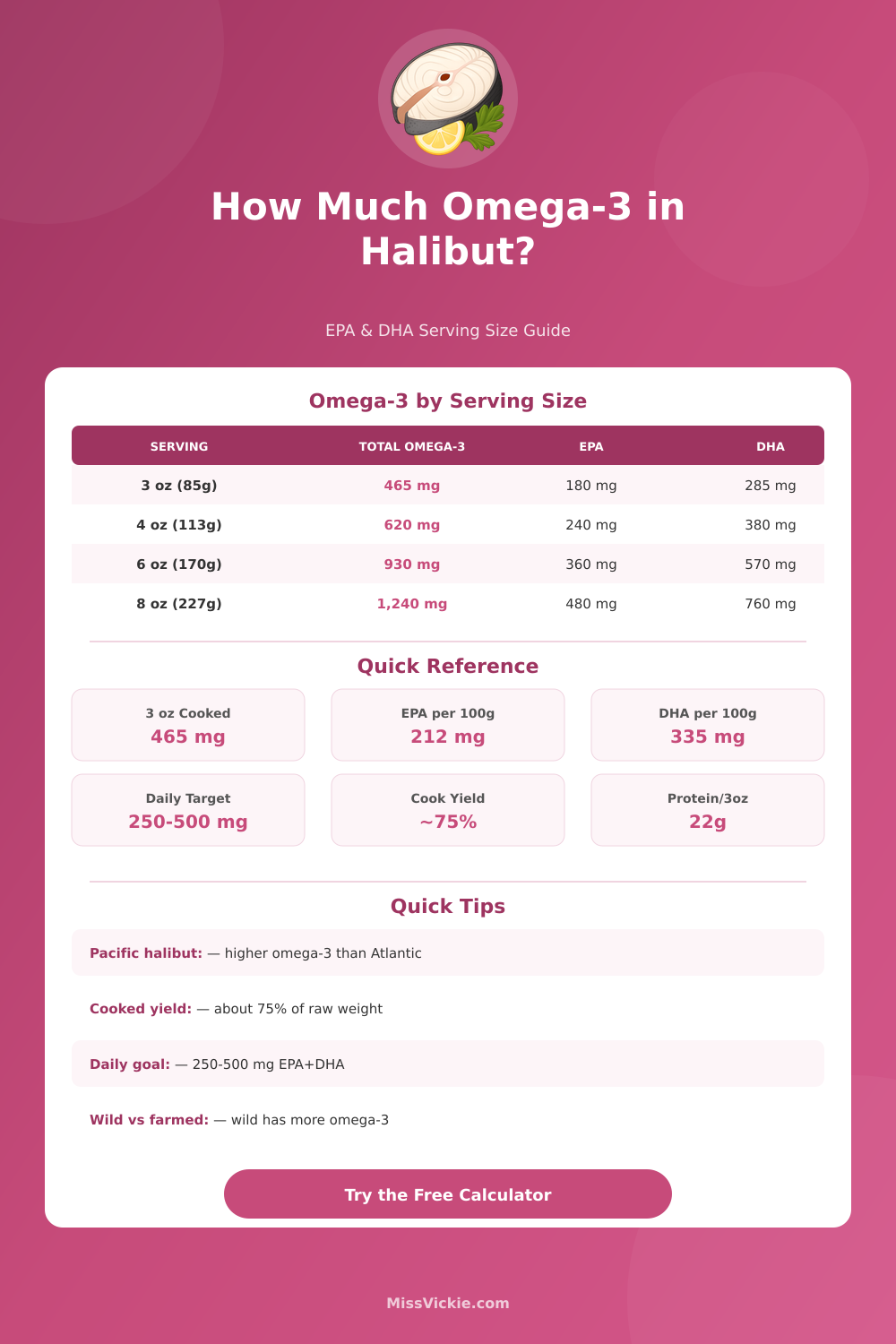
| Small (3 oz) | 85 g | 465 mg | 93% |
| Medium (4 oz) | 113 g | 618 mg | 124% |
| Standard (5 oz) | 142 g | 776 mg | 155% |
| Large (6 oz) | 170 g | 930 mg | 186% |
| Extra Large (8 oz) | 227 g | 1,242 mg | 248% |
| Half Pound (8 oz raw) | 170 g cooked | 930 mg | 186% |
| Fish | Total Omega-3 | EPA | DHA |
|---|---|---|---|
| Salmon (Atlantic, farmed) | 1,830 mg | 587 mg | 1,238 mg |
| Mackerel (Atlantic) | 1,023 mg | 429 mg | 594 mg |
| Sardines (canned) | 835 mg | 402 mg | 433 mg |
| Trout (Rainbow, farmed) | 812 mg | 260 mg | 552 mg |
| Halibut (Pacific) | 465 mg | 180 mg | 285 mg |
| Tuna (Yellowfin) | 237 mg | 54 mg | 183 mg |
| Cod (Atlantic) | 158 mg | 46 mg | 112 mg |
| Tilapia | 115 mg | 5 mg | 110 mg |
| State | Total Omega-3 | EPA | DHA |
|---|---|---|---|
| Raw | 407 mg | 158 mg | 249 mg |
| Cooked (dry heat) | 547 mg | 212 mg | 335 mg |
| Goal | Daily EPA+DHA | Halibut Needed (cooked) | Servings of 4 oz |
|---|---|---|---|
| General Wellness | 250 mg | 1.6 oz (46g) | 0.4 |
| Heart Health (AHA) | 500 mg | 3.2 oz (91g) | 0.8 |
| Elevated Triglycerides | 1,000 mg | 6.4 oz (182g) | 1.6 |
| Therapeutic (High Dose) | 2,000 mg | 12.8 oz (363g) | 3.2 |
| Max Recommended | 3,000 mg | 19.2 oz (545g) | 4.8 |
| Imperial | Metric | Common Description | Omega-3 (Pacific, cooked) |
|---|---|---|---|
| 1 oz | 28.35 g | Thin slice | 155 mg |
| 3 oz | 85 g | USDA serving | 465 mg |
| 4 oz | 113 g | Restaurant portion | 618 mg |
| 6 oz | 170 g | Dinner fillet | 930 mg |
| 8 oz (0.5 lb) | 227 g | Large fillet | 1,242 mg |
| 16 oz (1 lb) | 454 g | Full pound | 2,484 mg |
Pacific halibut delivers about 465 mg of combined EPA and DHA per 3 oz cooked serving, which honestly covers 93% of the 500 mg daily target most health organizations suggest.
The content of this article does not come from a computer or automatic translator. It is based on actual experiences of users, changes in forums and shared ideas from the community that one finds everywhere on the net.
Halibut: Nutrition, Types and Cooking Tips
Halibut is the common name for three species of flatfish from the family of right-eyed flatfish. The term comes from the Middle English words “haly”, which means saint, and “butte”, which points to flat fish. One gave it to that fish because of its use as traditional food during Catholic festivals and saint days.
In some places, other big flatfish receive the same name. Actually, four species bear the name halibut: Atlantic halibut, Pacific halibut, Greenland halibut and California halibut. The California halibut belong to the family of left-eyed flatfish while the three others are right-eyed.
Atlantic halibut rank among the biggest species of flatfish on the globe. Some of them reach lengths of 15 feet and live until 50 years. Pacific halibut also is impressive in size and the bigest in its group.
That fish is almost flat from one side to the other, swims in profile with one side below and the other up. An interesting fact about halibut is, that while the fish are still little, its left eye moves upward to the right side.
Officially, the biggest halibut was an Atlantic halibut, that a German fisherman caught in 2019 in Norwegian seas beside Kjollefjord. It had a length of 8.6 feet. Before, the record belonged to a 419-pound Atlantic halibut from 2004.
Also, one set another record with a 244-pound halibut, that passed two metres and was caught in Saguenay.
Pacific halibut live naturally in the North of the Pacific Ocean. Fishermen catch it for commercial, hobby and food use. Big Pacific halibut sometimes get called “barn doors” thanks to their huge size.
In United States, Alaskan halibut are considered white fishes for food. It is known because of its boneless, nicely tasting white meet.
Rounds of halibut have a sweet, gentle taste with texture, that is firm, yet tender. The meat is dense and white, with pink shades at the central line of the whole bit, that extends in the flesh. That particular structure is unique and hardly copied by other fish.
If you only want a base for sauce, even so, many species of firm white fishes can serve as replacements.
Halibut commonly cost a lot. It appears in prices of eight until nine dollars each pound in supermarkets, and even until sixty dollars each pound in certain fish markets. Spending more for halibut in fried dish does not always pay off.
Traditionally, fish and chips are made with cod. Although, well cooked halibut chips are unbeatable. If one cooks it bad or too long, it however turns into complete failure.
One can cook halibut in many ways. Grilling, pan-frying, baking and broiling all work well. The secret is to avoid overcooking.
A simple method is to dry the rounds, salt and pepper them, later burn in a check on medium-high heat for around three minutes each side. If one lets the fish calmly cook, it forms a nice golden crust. Another form is baking halibut at 400 degrees Fahrenheit.
Sauce from lemon, garlic and butter goes well with pan-fried bits. One also can lay halibut on a board, pour lemon juice, add lemon pepper, cover with butter and lemon rounds, and cook in a broiler or on a grill for 20 until 25 minutes, until it becomes tender.
Too long soaking of halibut in something bitter, like vinegar, can create troubles. For instance, grilled halibut, that sat in vinegar-based sauce for 30 minutes, became mushy and soft instead of firm and tender. When the skin is too thick, best remove it before cooking.
Usually one leaves the skin on halibut, while cod one sells without skin.
The advised serving of halibut is around six until eight units of normal weight each person. A third serving gives 16 grams of protein. Half a cooked round has 176 calories, where 86 percent is protein, 14 percent fat and zero percent carbs.
Eating at least two servings of fish weekly helps general health, and wild Pacific halibut provides nutrients that support normal growth andphysical health.