🍅 Tomato Puree ⇄ Fresh Tomato Calculator
Convert between fresh tomatoes and tomato puree with accurate yields and measurements
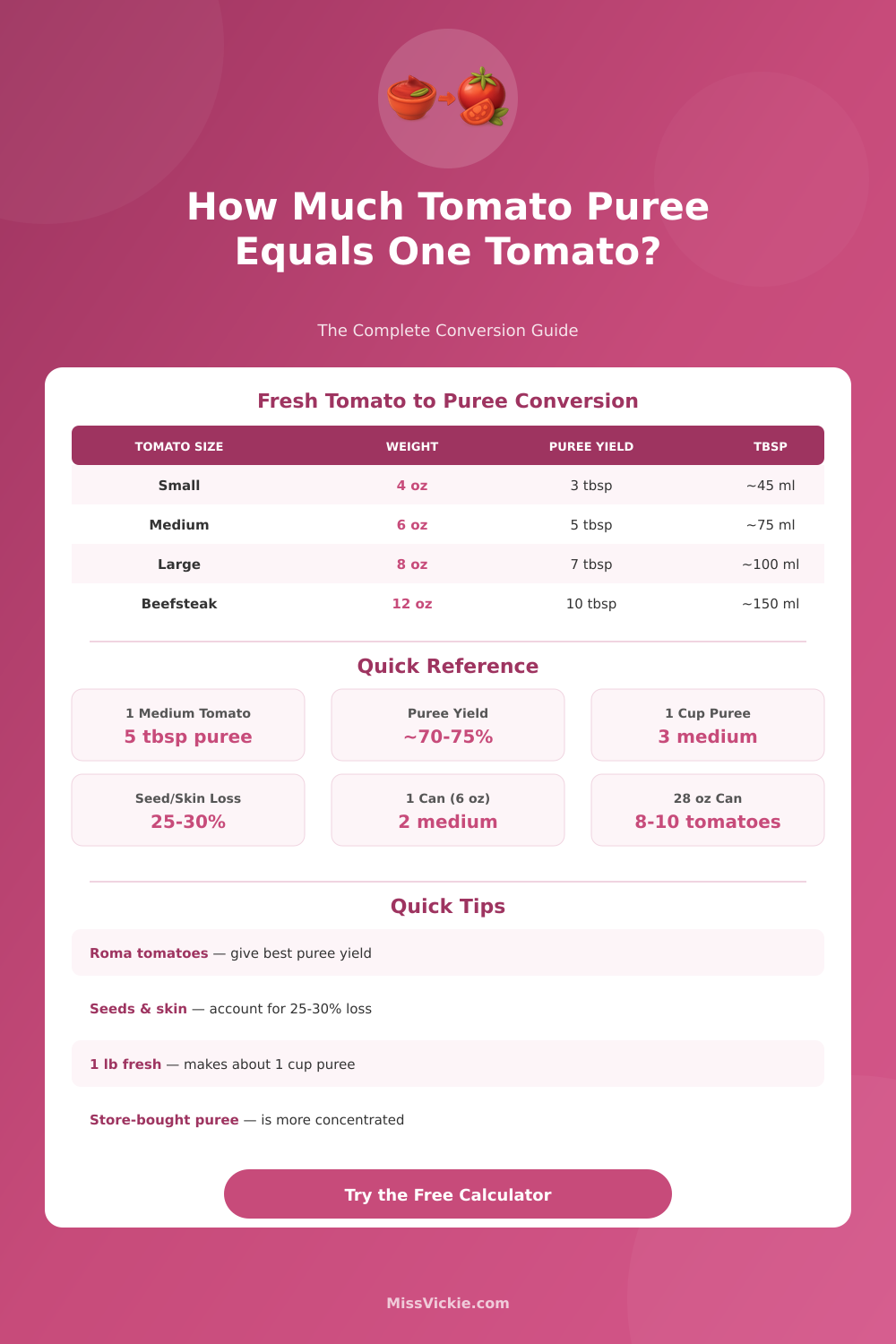
| Tomato Type | Avg. Weight | Puree Yield | Puree Amount |
|---|---|---|---|
| Small | 4 oz (113 g) | ~70% | 3 tbsp (45 ml) |
| Medium | 6 oz (170 g) | ~72% | 5 tbsp (75 ml) |
| Large | 8 oz (227 g) | ~73% | 7 tbsp (105 ml) |
| Beefsteak | 12 oz (340 g) | ~73% | 10 tbsp (150 ml) |
| Roma / Plum | 3 oz (85 g) | ~78% | 2.5 tbsp (37 ml) |
| Cherry (10 pcs) | 6 oz (170 g) | ~68% | 4.5 tbsp (67 ml) |
| Puree Amount | Medium Tomatoes | Roma Tomatoes | Weight (Approx.) |
|---|---|---|---|
| 1 tbsp (15 ml) | ⅓ tomato | ½ roma | 0.5 oz (16 g) |
| 2 tbsp (30 ml) | ½ tomato | 1 roma | 1 oz (30 g) |
| ¼ cup (60 ml) | 1 tomato | 1.5 romas | 2 oz (60 g) |
| ½ cup (120 ml) | 2 tomatoes | 3 romas | 4 oz (120 g) |
| 1 cup (240 ml) | 3 tomatoes | 5–6 romas | 8 oz (240 g) |
| 6 oz can (170 ml) | 2 tomatoes | 4 romas | 6 oz (170 g) |
| 28 oz can (794 ml) | 8–10 tomatoes | 14–16 romas | 28 oz (794 g) |
Per 100g serving comparison
| Puree Needed | Medium Tomatoes | Fresh Weight (lb) | Fresh Weight (kg) |
|---|---|---|---|
| ½ cup | 2 | 0.75 lb | 0.34 kg |
| 1 cup | 3 | 1.1 lb | 0.5 kg |
| 2 cups | 6 | 2.25 lb | 1.0 kg |
| 1 quart (4 cups) | 12 | 4.5 lb | 2.0 kg |
| ½ gallon (8 cups) | 24 | 9 lb | 4.1 kg |
| 1 gallon (16 cups) | 48 | 18 lb | 8.2 kg |
| Tomato Variety | Seeds & Juice Loss | Skin Loss | Total Trim Loss |
|---|---|---|---|
| Globe / Slicing | 18–22% | 5–7% | 25–28% |
| Roma / Plum | 12–15% | 5–7% | 18–22% |
| Beefsteak | 20–25% | 4–6% | 25–30% |
| Cherry / Grape | 22–28% | 6–8% | 28–35% |
| San Marzano | 10–14% | 5–6% | 16–20% |
One medium tomato weighing about 6 ounces yields roughly 5 tablespoons of puree, which is around 75 ml. Thats a 72% yield once you remove seeds and skin. Roma tomatoes are more efficient at 78%, so I always grab those when making puree from scratch.
Tomato Puree is made up of dense liquid, that one prepares by cooking and straining of tomatoes. It sits a bit between Tomato pulp and blended Tomato mix according to the texture. Compared with Tomato sauce, it has thicker makeup and richer flavor.
How to Make, Store and Use Tomato Puree
Simply deal about plain Tomato sauce, that does not carry extra spices. The idea of Tomato Puree changes according to the lands, what commonly causes mixes in the heads.
In United Kingdom, Tomato Puree genuinely matches to Tomato pulp. Hence, when a British recipe requires Tomato Puree, it usually means something genuinely dense, almost as pulp. This surprises many folks.
In Australia, the same thing is called Tomato sauce. Also one considers the Puree equal to Italian passata.
Preparing it at home is entirely easy. One way is to score the tomatoes on the top and bottom, blanch them with warm water, later move them in cool water. The bark goes off right away.
Later just lay them in a food processor and mix until smooth. Also, one can cut the tomatoes in halves along the beam and grate them on the big holes of a grater, keeping the cut part against the grate and dumping the skin. Some like to first remove the seeds and sort the tomatoes, then chop them, cook only that much that the extra water goes, and then blend.
Others skip the removal of skins and seeds, cook everything with those parts and strain later. Plum-tomatoes or Roman-tomatoes work well for that process. Cook fresh tomatoes slowly and later blend them to give Puree, that one can freeze for later use.
Homemade Tomato Puree is healthy, especially if one prepares it without removing the skin and seeds. Tomatoes blended without skin and seeds lose there fiber content.
Good quality store bought versions are based on ripe tomatoes, never from concentrate. Some are made from vine-ripened tomatoes, that one cooks and strains for a dense base. One washes and checks the tomatoes before chopping, straining and reducing them, without adding any outside ingredients.
Well preserved Tomato Puree, laid in a cold and dark place, can stay safely for twelve to eighteen months.
Tomato Puree works surprisingly as a base for sauces, soups, stews and dishes. It goes into foods like ratatouille, lentil soup, Mediterranean bean stew, beef Bourguignon, paella and chili with meat. Tomatoes also form the core of many tasty dishes.
In most recipes, one can swap canned tomatoes for Tomato Puree. Roughly, one average tomato matches to a quarter cup of Puree. Tomato sauce or blended tomato mix works as a good one-for-one replacement, that little changes the final dish.
Canned tomatoes make a chunkier sauce, while Puree gives smoother, although a stick blender cansmooth any chunky sauce.