💧 Water for Couscous Calculator
Get the perfect water-to-couscous ratio every time
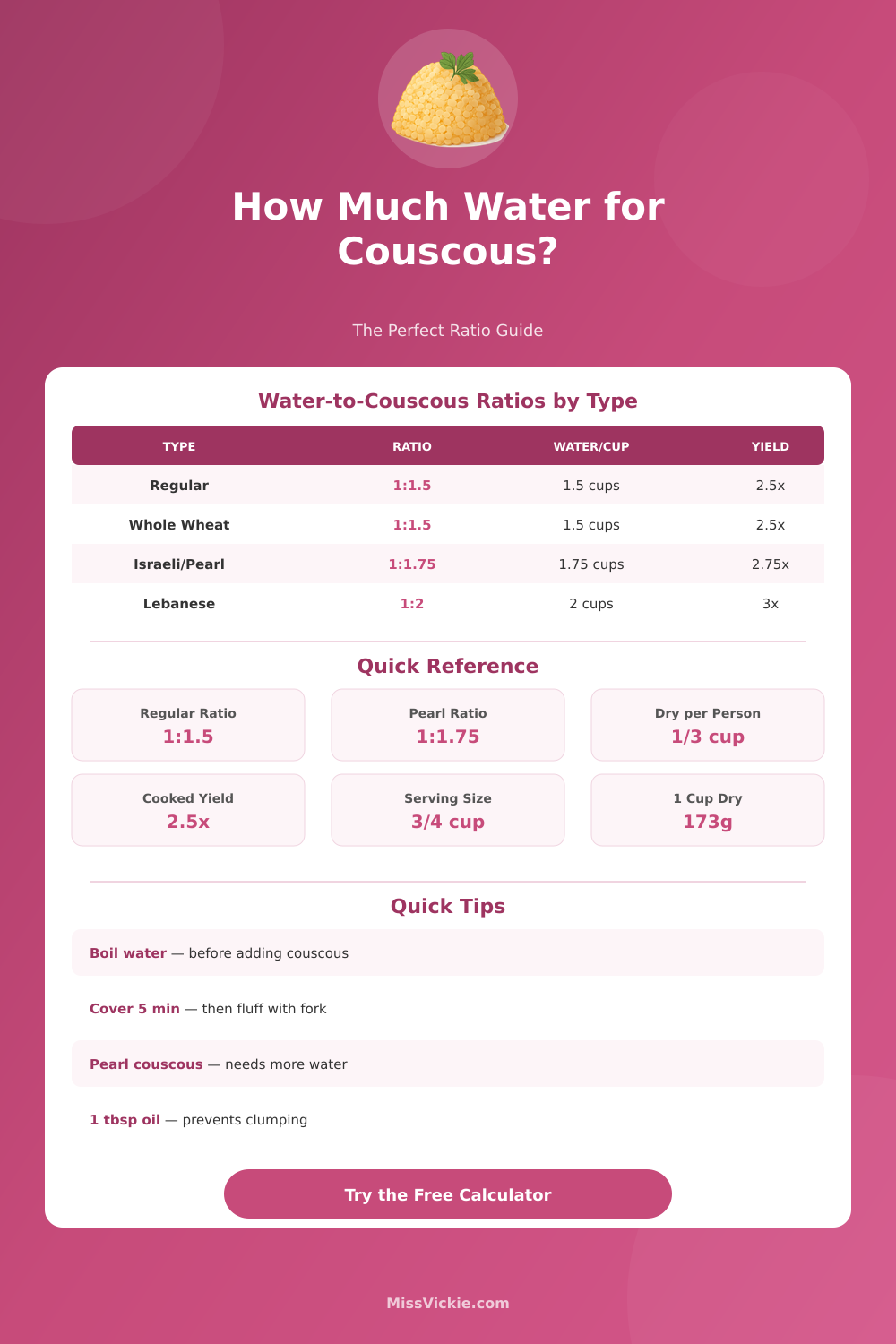
| Couscous Type | Ratio (Water:Couscous) | Water per 1 Cup Dry | Cooked Yield |
|---|---|---|---|
| Regular (Moroccan) | 1.5 : 1 | 1.5 cups (355 ml) | 2.5x volume |
| Whole Wheat | 1.5 : 1 | 1.5 cups (355 ml) | 2.5x volume |
| Israeli / Pearl | 1.75 : 1 | 1.75 cups (414 ml) | 2.75x volume |
| Lebanese (Moghrabieh) | 2 : 1 | 2 cups (473 ml) | 3x volume |
| Context | Dry per Person | Cooked per Person | Water per Person |
|---|---|---|---|
| Side Dish | 1/3 cup (60g) | 3/4 cup (150g) | 1/2 cup (118 ml) |
| Main Course | 2/3 cup (115g) | 1.5 cups (300g) | 1 cup (237 ml) |
| Salad Base | 1/2 cup (87g) | 1.25 cups (225g) | 3/4 cup (177 ml) |
| Buffet Side | 1/4 cup (45g) | 2/3 cup (112g) | 3/8 cup (89 ml) |
| Kids (under 12) | 3 tbsp (33g) | 1/3 cup (80g) | 1/4 cup (65 ml) |
| Guests | Dry Couscous | Water Needed | Cooked Yield |
|---|---|---|---|
| 2 | 2/3 cup (120g) | 1 cup (237 ml) | 1.5 cups (300g) |
| 4 | 1 1/3 cups (230g) | 2 cups (473 ml) | 3.3 cups (600g) |
| 6 | 2 cups (346g) | 3 cups (710 ml) | 5 cups (900g) |
| 10 | 3 1/3 cups (577g) | 5 cups (1,183 ml) | 8.3 cups (1.5 kg) |
| 15 | 5 cups (865g) | 7.5 cups (1,775 ml) | 12.5 cups (2.25 kg) |
| 20 | 6 2/3 cups (1.15 kg) | 10 cups (2.37 L) | 16.7 cups (3 kg) |
| 50 | 16 2/3 cups (2.88 kg) | 25 cups (5.9 L) | 41.7 cups (7.5 kg) |
| Measurement | Cups | Grams | Ounces |
|---|---|---|---|
| 1 tablespoon | 1/16 cup | 11g | 0.4 oz |
| 1/4 cup | 0.25 | 43g | 1.5 oz |
| 1/3 cup | 0.33 | 58g | 2 oz |
| 1/2 cup | 0.5 | 87g | 3.1 oz |
| 1 cup | 1 | 173g | 6.1 oz |
| 1 pound | 2.6 cups | 454g | 16 oz |
| 1 kg | 5.8 cups | 1,000g | 35.3 oz |
Couscous are one of those staples that requires minimal effort when cooked but features a crucial detail: how much water for couscous? Using too little will leave it crumbly, while too much will result in a mushy dish. Fortunately, its much more simpler than it seems once you know the correct water-to-couscous ratios.
Couscous doesnt requires boiling, unlike other pasta or rice products. All you have to do is pour hot water or broth over the couscous grains and cover the pot. The steam will cook the couscous for you for around five minutes. For regular couscous, the ideal ratio is 1.5 parts water to 1 part dry couscous by volume. One cup of dry couscous will require 1½ cups of water to make around 2½ cups of cooked couscous, perfect for four serving of the side dish.
Water Ratios by Couscous Type
Depending on the type of couscous you use, the water ratio change. For pear or Israeli couscous, you’ll want to use a 1.75:1 ratio, 1¾ cups of water for 1 cup of dry couscous. Cook it in simmering broth for 8 to 10 minutes. For Lebanese (moghrabieh) couscous, which features the most big grains of all types, use a 2:1 ratio and simmer for 20 minutes. For whole wheat couscous, use the regular 1.5:1 ratio but expect a slightly longer cooking time.
Always measure out your dry couscous first. A cup of couscous weigh 173 grams. Use a liquid measuring cup for the water. Boil the water and add a pinch of salt and a teaspoon of olive oil or butter for extra fluffiness. Fluff the couscous with a fork once it’s cooked and before serving. Do not peek into the pot while the couscous is resting. Use the calculator above to easily calculate the amount of water needed for any amount of dry couscous or any type.
Couscous ratios change depending on the dish you are preparing. For side dish use ⅓ cup of dry couscous per person (½ cup water). For main dish use ⅔ cup of dry couscous per person (1 cup water). Less water are needed for salads. Use vegetable, chicken, or tomato broth instead of water for flavorful results. Add salt when boiling the water, but do not use too much as the salt will concentrate during the cooking process.
Some common issues with couscous include using old couscous, which does not absorb water as good. Store couscous in airtight container when not in use. In high altitude, use 10% more water. You can reheat leftovers in the microwave by adding a splash of water. With these tips and tricks, youll perfect couscous every time in your kitchen.