🍖 Lamb Chop Protein Calculator
Calculate protein, calories, and macros for any lamb chop serving
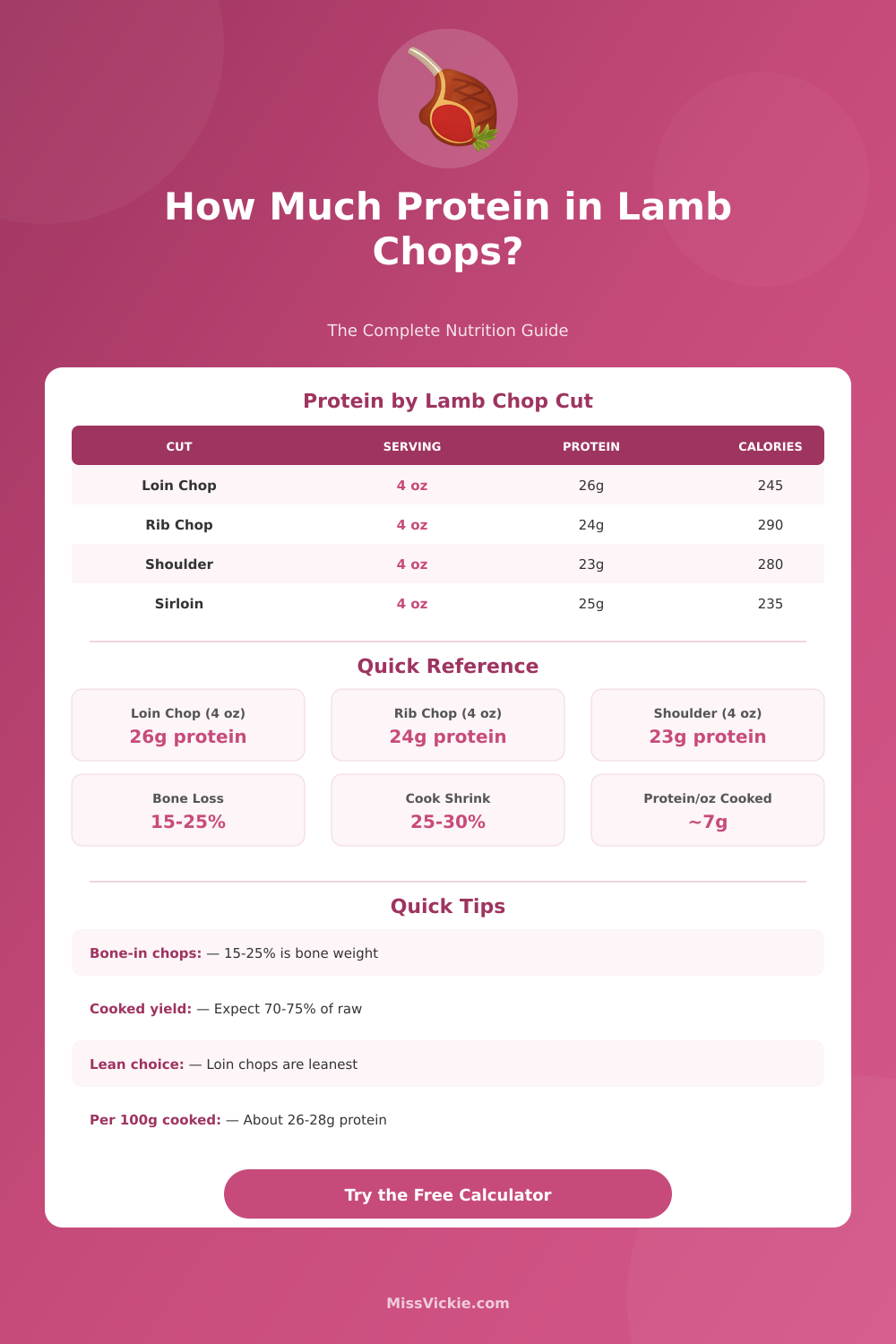
| Cut | Protein (g) | Calories | Total Fat (g) | Sat Fat (g) |
|---|---|---|---|---|
| Loin Chop | 26 | 245 | 16 | 6.8 |
| Rib Chop | 24 | 290 | 21 | 9.0 |
| Shoulder Chop | 23 | 280 | 20 | 8.2 |
| Sirloin Chop | 25 | 235 | 14 | 5.9 |
| Context | Serving (oz) | Serving (g) | Protein (Loin) |
|---|---|---|---|
| Appetizer portion | 2–3 oz | 57–85g | 13–19g |
| Casual main course | 4–5 oz | 113–142g | 26–33g |
| Formal dinner | 5–6 oz | 142–170g | 33–39g |
| Buffet serving | 3–4 oz | 85–113g | 19–26g |
| Restaurant portion | 6–8 oz | 170–227g | 39–52g |
| Children (4–12 yrs) | 2–3 oz | 57–85g | 13–19g |
| Cut | Cook Yield | Bone Loss | Edible Cooked % |
|---|---|---|---|
| Loin Chop (bone-in) | 72% | 15% | 61% |
| Rib Chop (bone-in) | 70% | 20% | 56% |
| Shoulder Chop (bone-in) | 68% | 25% | 51% |
| Sirloin Chop (bone-in) | 72% | 18% | 59% |
| Loin Chop (boneless) | 73% | 0% | 73% |
| Rib Chop (boneless) | 71% | 0% | 71% |
| Cut | Raw (per 100g) | Cooked (per 100g) | Increase |
|---|---|---|---|
| Loin Chop | 20g | 26g | +30% |
| Rib Chop | 18g | 24g | +33% |
| Shoulder Chop | 17g | 23g | +35% |
| Sirloin Chop | 19g | 25g | +32% |
Cooked loin chops of lamb weighing 4 ounces give around 26 g of protein what really pushes it as one of the most packed protein sources that I have found. Rib chops have a bit less, about 24 g for same weight. Here is why: rib parts carry more fat, around 21 g for 4 ounces compared to 16 g in loin.
That creates a big difference in nutrition values.
Lamb Chops: Protein, Cooking and Serving Tips
Raw lamb stores less protein in 100 grams. Between 18 and 20 g, depending on the cut, but cooking removes 25 to 30 percent of the water, what thickens everything. Because of that, the amount in cooked cuts goes up to 23-26 g in 100 grams.
I did not expect such change.
Chops with bone lose from 15 percent in loin to 25 percent in shoulder, only because of the bone mass. Sirloin cuts are around 18 percent, and they are the most lean option with only 14 g of fat for 4 ounces cooked. For a normal meal I plan usually 5 ounces cooked each plate…
That is around 142 grams, what delivers to every guest almost 33 g of protein from loin itself. For buffet it drops to 3 ounces each person, around 85 g, what gives about 19 g protein.
The information below does not come from any calculator or converter program on this page. It is based on real research, forum talks and cooking experiences from communities found through the net.
Lamb chops form simple and pleasant food. They work surprisingly for romantic evening dinner or festive dinner, that guests will not forget. Between the most liked are loin chops of lamb and rib chops.
One also calls them T-bone chops, because they look like little T-shaped steaks. They come from the saddle or short loin of the animal, with two muscles: strip loin and tenderloin. Such chops are lean, moist and easily available at the meat section in supermarkets.
Usually they have three to four ounces for one serving.
Lamb ranks between the most delicious common meats. Even without oil or sauce, it still has excellent flavor. It most commonly is different than pork chops.
The taste falls a bit between beef and pork. One can prepare lamb chops simply as steaks. Everthing what works for steak, works also for lamb.
A cast iron pan helps a lot for cooking lamb chops at home. Burning them in a pan with garlic and herbs gives nice crust outside, while the inner part stays juicy. Instead of cooking, dry the chops with paper towel (that is the key to reaching crispness).
Letting them rest at room heat for around thirty minutes before starting is also useful. Salt them forty minutes before grilling to act as brine, that releases juice and later lets the meat take it back, for more strong taste.
Garlic and rosemary form a classic combination with lamb. Besides that, one can season with thyme, salt and pepper, then cook on medium-to-high heat until brown crusts form. A mix from honey, Dijon mustard, garlic, rosemary and red wine is another good idea.
Even bottled Italian dressing works as easy mix during four to eight hours before grilling.
During cooking, avoid crowding the pan. Leave at least one inch between every chop and cook in batches if needed. For thinner cuts, two minutes each side are a good start.
For thick double ribs or loin chops above one inch and a quarter, around six minutes each side on a covered grill works well. After cooking, the chops must rest five minutes before serving.
Potatoes work well as a side food. Boiled and mashed with milk, butter and salt, then beaten smooth with cream, they go well. Carrots and salads also go with lamb chops.
Braised chops over egg noodles with Dijon mustard extra sauce forms another greatatttempt. Lamb chops even can become stew with potatoes, carrots, chickpeas, celery and onions.