🍷 Wine Alcohol Calculator
Calculate the exact alcohol content in your wine by type, serving size & quantity
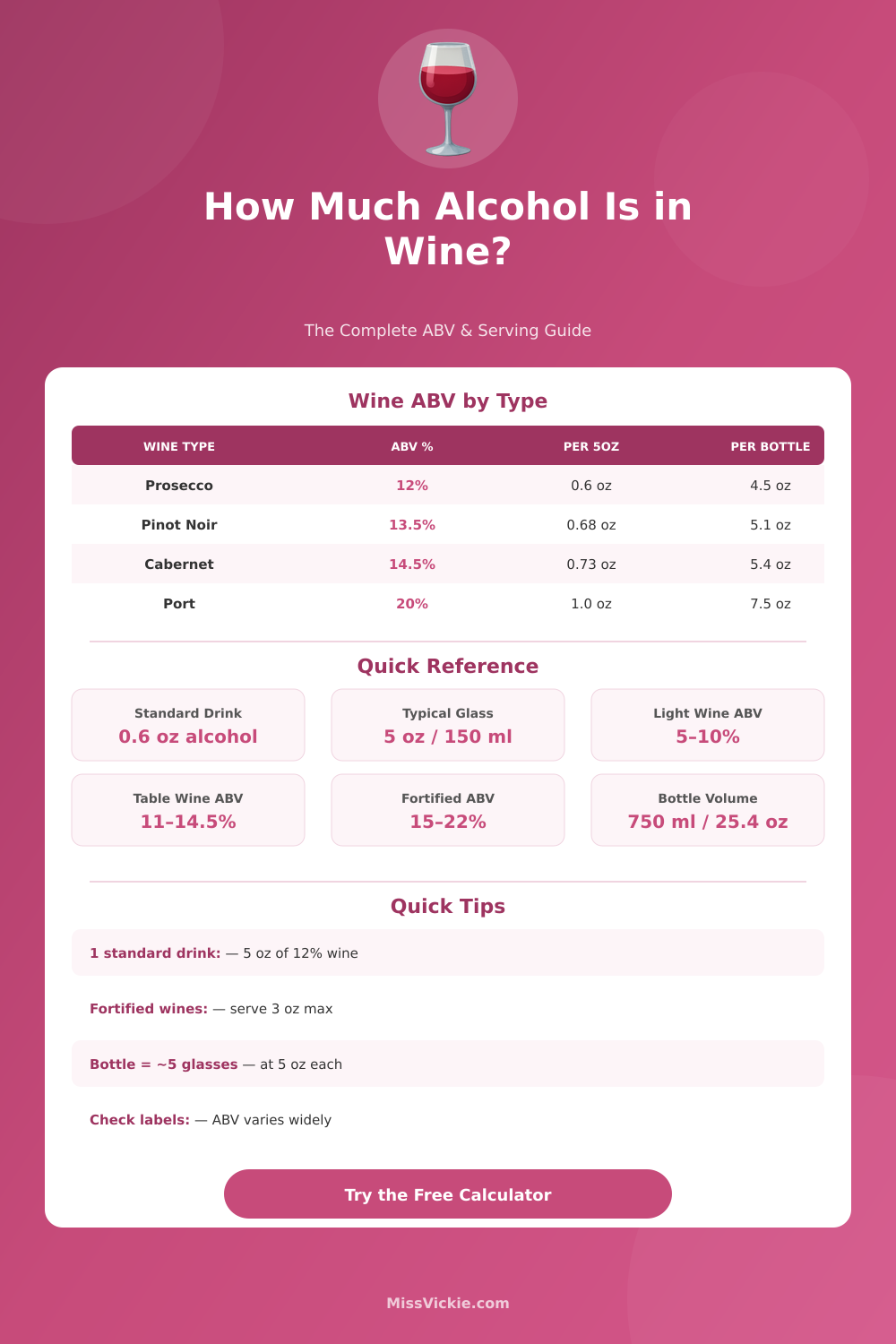
| Wine Type | ABV Range | Typical ABV | Category |
|---|---|---|---|
| Moscato d'Asti | 5–6.5% | 5.5% | Low Alcohol |
| Riesling (German) | 7–11% | 9% | Light |
| Vinho Verde | 8–11% | 9.5% | Light |
| Prosecco | 11–12.5% | 12% | Medium |
| Champagne | 11.5–12.5% | 12% | Medium |
| Rosé | 11–13.5% | 12% | Medium |
| Pinot Grigio | 11–13% | 12.5% | Medium |
| Sauvignon Blanc | 11.5–13.5% | 12.5% | Medium |
| Pinot Noir | 12–14% | 13% | Medium-Full |
| Chardonnay | 12.5–14.5% | 13.5% | Medium-Full |
| Merlot | 12.5–14.5% | 13.5% | Medium-Full |
| Malbec | 13–15% | 14% | Full |
| Cabernet Sauvignon | 13–15.5% | 14.5% | Full |
| Syrah / Shiraz | 13.5–15.5% | 14.5% | Full |
| Zinfandel | 14–17% | 15% | Full |
| Sherry | 15–22% | 17% | Fortified |
| Marsala | 15–20% | 18% | Fortified |
| Port | 18–22% | 20% | Fortified |
| Madeira | 18–22% | 19% | Fortified |
| Container | Volume (oz) | Volume (ml) | Std Drinks (12% ABV) |
|---|---|---|---|
| Tasting Pour | 2 oz | 60 ml | 0.4 |
| Dessert / Fortified Pour | 3 oz | 90 ml | 0.6 |
| Standard Glass (U.S.) | 5 oz | 148 ml | 1.0 |
| Standard Glass (UK) | 5.9 oz | 175 ml | 1.2 |
| Large Glass (UK) | 8.5 oz | 250 ml | 1.7 |
| Half Bottle | 12.7 oz | 375 ml | 2.5 |
| Standard Bottle | 25.4 oz | 750 ml | 5.0 |
| Magnum | 50.7 oz | 1,500 ml | 10.0 |
| Box Wine (3L) | 101.4 oz | 3,000 ml | 20.0 |
| Measurement | Equivalent | Notes |
|---|---|---|
| 1 fl oz pure alcohol | 23.3 grams | Alcohol density = 0.789 g/ml |
| 1 U.S. standard drink | 0.6 fl oz / 14 g | NIAAA definition |
| 1 UK unit | 10 ml / 8 g | UK health guidelines |
| 1 Australian std drink | 10 g pure alcohol | 12.7 ml pure alcohol |
| 5 oz of 12% wine | 0.6 fl oz / 14 g alcohol | = 1 U.S. standard drink |
| 750 ml of 13.5% wine | 80 g pure alcohol | = 5.7 U.S. standard drinks |
| ABV % | Pure Alcohol (fl oz) | Pure Alcohol (g) | U.S. Std Drinks |
|---|---|---|---|
| 5.5% (Moscato) | 1.40 | 32.5 | 2.3 |
| 9% (Riesling) | 2.29 | 53.2 | 3.8 |
| 12% (Prosecco) | 3.05 | 71.0 | 5.1 |
| 13.5% (Chardonnay) | 3.43 | 79.8 | 5.7 |
| 14.5% (Cabernet) | 3.68 | 85.7 | 6.1 |
| 15% (Zinfandel) | 3.81 | 88.7 | 6.4 |
| 20% (Port) | 5.08 | 118.4 | 8.5 |
Glass of wine with 12% ABV holds around 0.6 ounces of pure alcohol, around 14 grams what matches one standard drink. If you take wine up to 13.5% like Chardonnay, then a glass gets to 16 grams. Not that big a difference, but it adds up quickly during a whole meal.
About full bottles, light 5.5% Moscato reaches around 2.3 standard drinks for 750 ml, while 20% Porto reaches a heavy 8.5. I was surprised to learn that 15% Zinfandel is quite common, what matches 6.4 drinks per bottle. Every gram of alcohol has 7 calories, so a 12% glass gives around 121 calories, while 14.5% Cabernet reaches about 147.
Wine Basics: Types, Serving Size and Alcohol
For comparison, in United Kingdom one uses an 8-gram standard for a drink, so that 12% glass would match rughly 1.8 British units.
Wine is an alcoholic drink from fermented grape juice. One makes it and stores it everywhere in the world, with big variety of styles based on the grapes, the places where they grow, the way one farms them and the process of winemaking. The main kinds are white, red, pink, sparkling and strengthened or dessert wines.
Interestingly, white wines commonly come from green, yellow, red or orange-skinned grapes, not what one would expect from the name.
Wine is a living, changing thing. When it is fresh, it lives and buzzes; while it ages, new layers of flavor appear. There is a clear difference between good and bad wine, and higher standards go beyond simple personal taste.
Factors like the whole balance between bitterness, tannins, oak and leftover sugar, as well as precise fruity and non-fruity smells and the lasting of the tastes, define good wine.
The usual size of a wine bottle is 750 ml, or around 25 ounces. It became a global standard in the 1970s, when Europe standardized it and United States with Canada followed the example. Normal amount for a pour is around 5 ounces, so one bottle gives roughly 5 glasses.
For tasting, one pours about 2-3 ounces, while wines with higher alcohol, like Bordeaux or Zinfandel, one serves a bit fuller, at 4.5-5 ounces. A Magnum bottle has 1.5 liters, what matches too average bottles and is enough for 4-5 people.
Cooking with wine is a whole world on its own. White wine widely works for dishes without beef. The bottled “cooking wines” that one sees are not ideal; they usually have low quality and much sodium.
In French cooking, one commonly uses wine to cook meat long or to create tasty sauces. A good method is to pour white wine in the pan at the end of frying, let it reduce to around two thirds, then add the other ingredients. In restaurants, most wine for cooking is simply basic table wine, and there is no shame in doing the same athome.
Wine, bread and cheese form a classic pair, especially if one adds a bit of blue cheese. For wine tastings, a dish with cheese and fruits is a safe choice. Red wines are traditionally served at room temperature instead of cooled.
Cabernet Sauvignon is commonly described for its “black currant” flavor, but because currants are not commonly eaten in United States, that is not always the best description for everyone.
Here is the main point though. Although I try to explain it as simply as possible, there really is no replacement for diving into the wonderful world of wine and exploring it yourself. All the technical details in the world can not capture the joy of finding new tastes and making your own connections.
So pour yourself a glass, take a sip and start to taste!