🍚 Arborio Rice Per Person Calculator
Calculate the perfect amount of arborio rice for any gathering
| Serving Type | Grams (dry) | Ounces (dry) | Cups (dry) |
|---|---|---|---|
| Appetizer / Starter | 40g | 1.4 oz | ~3 Tbsp |
| Side Dish | 60g | 2.1 oz | ~¼ cup + 1 Tbsp |
| Main Course (Risotto) | 100g | 3.5 oz | ~½ cup |
| Buffet | 75g | 2.6 oz | ~⅓ cup |
| Hearty Main | 120g | 4.2 oz | ~⅔ cup |
| Guests | Dry Rice (g) | Dry Rice (lbs) | Cooked Yield (g) |
|---|---|---|---|
| 2 | 200g | 0.44 lb | 550g |
| 4 | 400g | 0.88 lb | 1,100g |
| 6 | 600g | 1.32 lbs | 1,650g |
| 10 | 1,000g | 2.2 lbs | 2,750g |
| 15 | 1,500g | 3.3 lbs | 4,125g |
| 20 | 2,000g | 4.4 lbs | 5,500g |
| 25 | 2,500g | 5.5 lbs | 6,875g |
| 50 | 5,000g | 11.0 lbs | 13,750g |
| Measure | Grams | Ounces | Notes |
|---|---|---|---|
| 1 cup dry arborio | 200g | 7.05 oz | Slightly heavier than long-grain |
| ½ cup dry arborio | 100g | 3.5 oz | Standard 1-person main serving |
| ¼ cup dry arborio | 50g | 1.76 oz | Small side serving |
| 1 Tbsp dry arborio | 13g | 0.46 oz | — |
| 1 cup cooked risotto | 175g | 6.2 oz | Approximate, depends on liquid |
| 1 kg dry arborio | 1,000g | 35.3 oz | Serves 10 (main course) |
| Dry Rice Amount | Broth / Liquid Needed | Ratio | Cooked Yield |
|---|---|---|---|
| 100g (½ cup) | 300–400 ml | 3:1 to 4:1 | ~275g |
| 200g (1 cup) | 600–800 ml | 3:1 to 4:1 | ~550g |
| 400g (2 cups) | 1.2–1.6 L | 3:1 to 4:1 | ~1,100g |
| 1 kg (5 cups) | 3–4 L | 3:1 to 4:1 | ~2,750g |
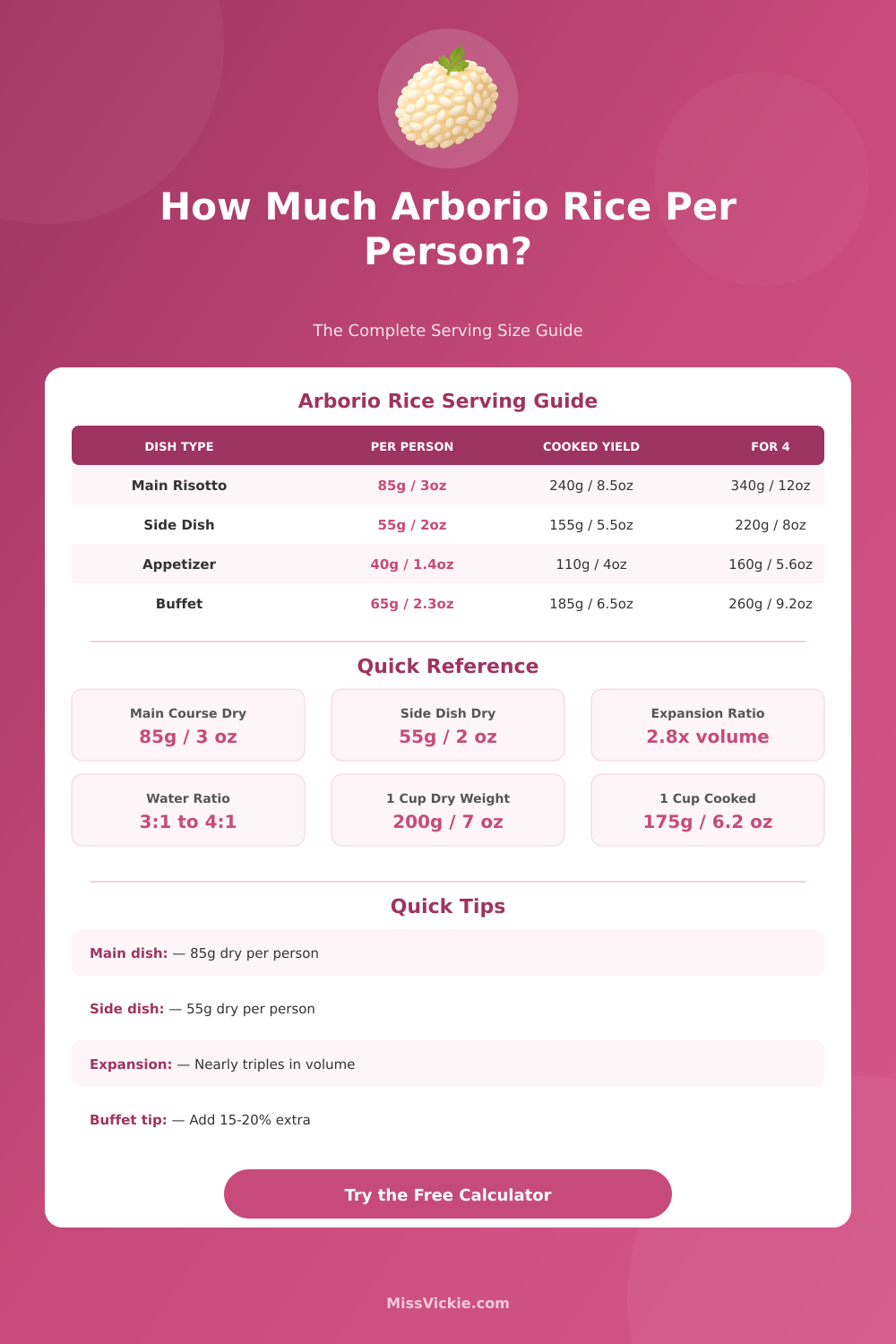
When risotto is the main plate in the centre of the meal one uses around 100 g (3,5 oz) of dry arborio rice for every person. For a side dish one reduces it to 60 g (2,1 oz) for each person, while for a starter Italian cooking tradition suggests 40 g (1,4 oz). At a buffet the portions drop a bit lower (around 75 g (2),6 oz) of dry rice for every guest.
Arborio rice expands at about a 2,75:1 ratio of dry to cooked weight. So 100 g of dry arborio turns into around 275 g of finsihed risotto, while 1 cup (200 g) of dry rice gives almost 550 g (near 3 cups) after cooking. That clearly beats long grain white rice that expands only at 2,5:1.
How Much Arborio Rice for Risotto
The reason lies in the higher content of starch in arborio… About 21% rather than 15, 18% in usual types.
One cup of dry arborio rice weighs around 200 g (7,05 oz), what makes it 10, 15% heavier per cup than long grain rice at 185 g. One spoon of dry arborio reaches 13 g (0,46 oz).
Here is how the math works out four portions of main plate for a group: at 100 g per person, multiply by headcount and round up to the nearest convenient package size.
In professional kitchens and catering services arborio is usually portioned at 80; 110 g of dry per person for main risottos, depending on what else goes with it. When risotto comes as first plate before the second. For events with 20 or more guests, plan to add 15% extra, so for a 50-person event with main risotto one plans around 5,75 kg instead of simply 5 kg.
The ratio of liquid to rice for risotto sits between 3:1 and 4:1 by volume. For 200 g (1 cup) of dry arborio that means 600, 800 ml (2,5, 3,4 cups) of warm broth. There is no one perfect number, because risotto depends on gradual absorption and many factors all affect it.
Loose-style risotto, like that of @Silky, will lean more to the 4:1 end of the range.
Per 100 g of dry arborio rice carries around 356 calories, along with 6,5 g of protein, 77 g of carbs (with only 0,4 g of fiber) and 0,6 g of fat. It also gives around 1,2 mg of iron (15% of the daily need) and 69 mg of phosphorus. Compared with brown rice at 370 calories per 100 g of dry, arborio has a bit less calories but much less fiber, 0,4 g against 3,4 g per 100 g.
Different eating habits naturally change the portion tips by some percentages. Older adults commonly choose 15, 20% under the standard, so around 80, 85 g of dry for main plate.
Arborio also has almost no waste or loss. Unlike meats with bones or peels, 100% of the dry rice gets used. The only real loss comes from what stays in the pot, usually 2, 4% of the cooked batch.
With big amounts in cooking even that percentage drops under 1,5%.