🧈 Salt in Salted Butter Calculator
Calculate exactly how much salt and sodium is in any amount of salted butter
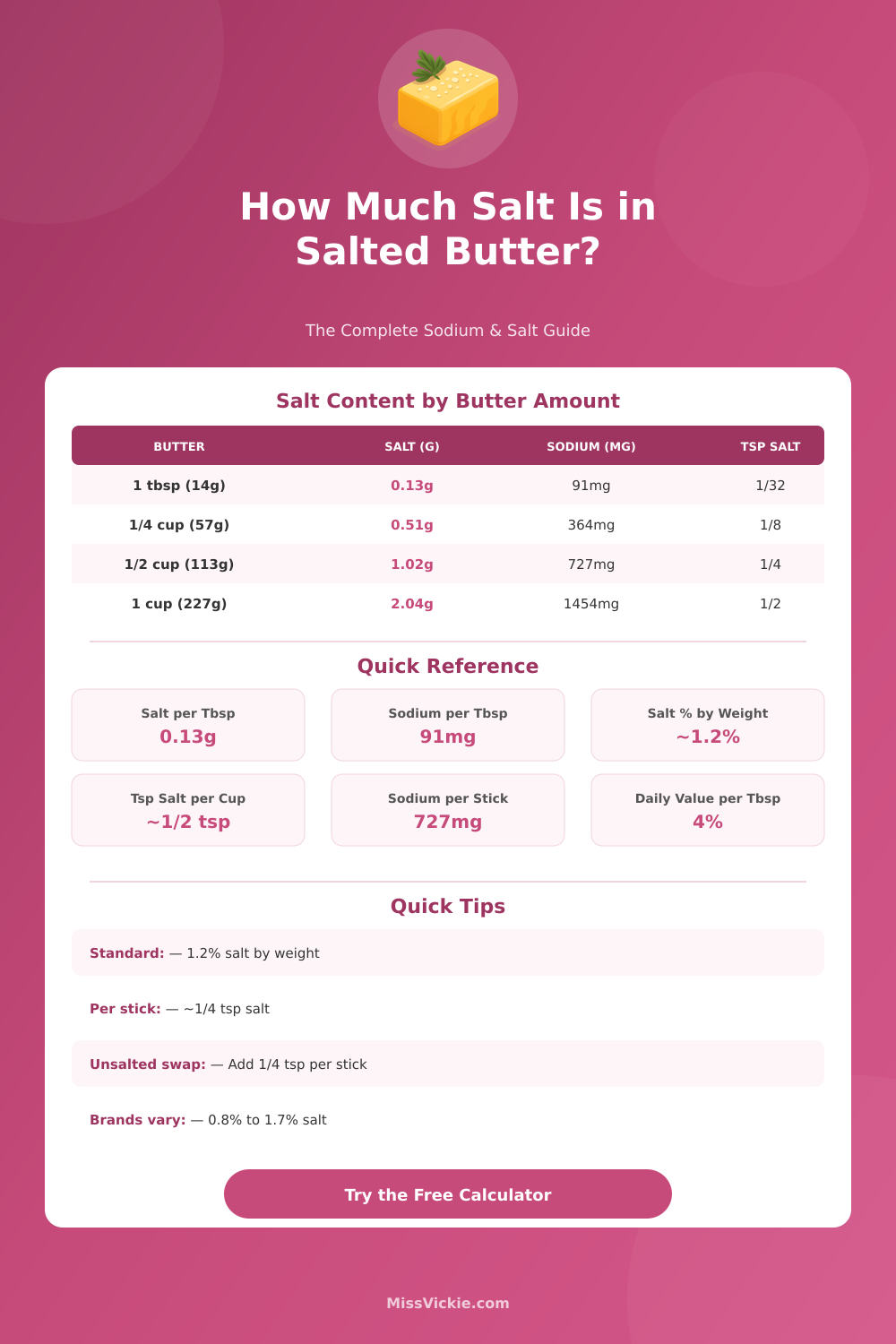
| Butter Amount | Weight (g) | Salt (g) | Sodium (mg) | Tsp Salt |
|---|---|---|---|---|
| 1 tsp (pat) | 4.7g | 0.06g | 23mg | ~1/100 |
| 1 tablespoon | 14.2g | 0.17g | 91mg | ~1/35 |
| 2 tablespoons | 28.4g | 0.34g | 182mg | ~1/17 |
| 1/4 cup (4 tbsp) | 56.7g | 0.68g | 364mg | ~1/9 |
| 1/3 cup | 75.7g | 0.91g | 485mg | ~1/7 |
| 1/2 cup (1 stick) | 113.4g | 1.36g | 727mg | ~1/4 |
| 3/4 cup | 170.1g | 2.04g | 1,091mg | ~1/3 |
| 1 cup (2 sticks) | 226.8g | 2.72g | 1,454mg | ~1/2 |
| 1 pound (4 sticks) | 453.6g | 5.44g | 2,908mg | ~1 |
| Brand | Salt % by Weight | Sodium per Tbsp (mg) | Salt per Stick (g) |
|---|---|---|---|
| USDA Average | 1.2% | 91mg | 1.36g |
| Land O'Lakes | ~1.4% | ~100mg | ~1.59g |
| Kerrygold Irish | ~1.2% | ~85mg | ~1.36g |
| Lurpak Salted | ~1.0% | ~71mg | ~1.13g |
| Challenge Butter | ~1.3% | ~90mg | ~1.47g |
| President (French) | ~1.0% | ~71mg | ~1.13g |
| Store Brand (avg) | 1.1–1.5% | 80–105mg | 1.24–1.70g |
| Light / Low-Salt | ~0.8% | ~57mg | ~0.91g |
| Unsalted Butter | Add This Much Salt | = Equivalent Salted |
|---|---|---|
| 1 tablespoon (14g) | 1/32 tsp (0.17g) | 1 tbsp salted butter |
| 1/4 cup (57g) | 1/8 tsp (0.68g) | 1/4 cup salted butter |
| 1/2 cup / 1 stick (113g) | 1/4 tsp (1.36g) | 1 stick salted butter |
| 1 cup / 2 sticks (227g) | 1/2 tsp (2.72g) | 1 cup salted butter |
| 1 pound / 4 sticks (454g) | 1 tsp (5.44g) | 1 lb salted butter |
| Measurement | Grams | Ounces | Tablespoons |
|---|---|---|---|
| 1 pat | 5g | 0.18 oz | 1 tsp |
| 1 tablespoon | 14.2g | 0.5 oz | 1 |
| 1/4 cup | 56.7g | 2 oz | 4 |
| 1 stick (US) | 113.4g | 4 oz | 8 |
| 1 cup | 226.8g | 8 oz | 16 |
| 1 pound | 453.6g | 16 oz | 32 |
| 1 kilogram | 1,000g | 35.3 oz | ~70 |
According to data from USDA, standard American salted butter stores around 1,2 % of salt by weight. That matches to almost 1,36 grams of salt in one 113,4-gram stick. Every spoon (14,2 g) of average salted butter gives 91 milligrams of sodium, about 4 % of the 2 300 milligrams daily suggested by FDA.
Because sodium chloride is made up of around 39,34 % sodium by molecular mass, every gram of salt in butter adds about 393 milligrams of sodium.
How Much Salt Is in Salted Butter
One American stick of salted butter weighs 113,4 grams (4 units) and delivers between 680 and 800 milligrams of sodium depending on the brand that comes in the store. The National Food Database of USDA points 643 milligrams of sodium for 100 grams of salted butter. Double that for two sticks (1 cup, 226,8 grams), and the sodium reaches around 1 454 milligrams, around 63 % of the daily suggested amount.
On the other hand, a small piece of butter, usually 5 grams, has only 23 milligrams of soduim.
Brands differ quite a lot. Salted butter from Land O’Lakes has around 100 milligrams of sodium per spoon, what puts its salt level at about 1,4 % by weight. Kerrygold from Ireland is a bit lower, with around 85 milligrams of sodium per 14-gram serving, more near 1,2 %.
European-style types like Lurpak and Président commonly have less, around 1,0 % of salt, what gives around 71 milligrams of sodium per spoon. Butters from store brands in United States range from 80 to 105 milligrams of sodium per spoon, a range that matches about 1,1 % to 1,5 % of salt by weight.
When switching salted butter to unsalted, for every half cup (one stick) of salted butter, remove around 1/4 spoon of other salt from the recipe. To understand, one spoon of table salt weighs 6 grams and carries 2 325 milligrams of sodium. So, a full pound (453,6 grams) of salted butter with 1,2 % of salt level has around 5,44 grams of salt; equal to almost 0,9 spoons of table salt.
One spoon of salted butter gives 102 calories, 11,5 grams of total fat (of that 7,3 grams saturated), 31 milligrams of cholesterol and only 0,12 gram of protein. It is made up of around 80… 82 % of milk-fat, 16, 18 % of water and 1, 2 % of milk solids by weight, with salt in the remaining 0,8, 1,7 %.
Unsalted butter usually has a bit more fat (around 81), 83 %; because it does not contain salt displacing other components.
In baking, replacing 1 cup of unsalted butter with salted butter adds around half a spoon (2,72 grams) of salt to the dough. A typical recipe for cake that requires 1 cup of butter and 1 spoon of salt, using salted butter without changes could raise the total salt level by around 45 %. Professional bakeries advise reducing the extra salt accordingly when salted butter is used as replacement.
Considering bigger amounts, a 1-kilogram package of salted butter with standard 1,2 % stores 12 grams of salt and 4 720 milligrams of sodium. That kilo divides into around 70 spoons. Some butters have 1,7 % of salt, what means 17 grams of salt and 6 687 milligrams of sodium per kilo.
That is 42 % more than the usual recipe.
According to rules of FDA, any butter sold as “salted” must show the sodium amount on the nutrition label. Commercial processes allow small variety of around ±0,2 percentage points of the intended salt level. Practically, butter intended for 1,2 % of salt can range from 1,0 % to 1,4 % in the same product line.
Compared to other common sodium sources in the kitchen, salted butter is in the middle range. One spoon of soy sauce stores around 879 mg of sodium. Almost 9,7 times more than butter.
One spoon of salted butter sits between a big egg (62 mg) and a slice of American cheese (266 mg). Margarine has around 105 mg of sodium per spoon, what is almost 15 % morethan standard salted butter.